dimarts, 30 de gener del 2018

'We Weren't Prepared for This.' Inside the Accidental Liberation of a Concentration Camp

'We Weren't Prepared for This.' Inside the Accidental Liberation of a Concentration Camp

In early 1945, World War II was approaching its end in Europe, a conclusion that would officially arrive when the Germans surrendered to the Allies on May 7, 1945. In practice, that final period of the war was also the beginning of a new phase of the conflict, as troops and the general public alike began to discover the extent of the atrocities they’d been fighting over.
In some ways, that reckoning continues to this day. The timing of International Holocaust Remembrance Day, which falls this Saturday, commemorates the anniversary of the Soviet Army liberating more than 7,000 prisoners of Auschwitz on Jan. 27, 1945. In the months that followed, troops from the USSR, Western Europe and the U.S. would liberate many more camps, as the Nazis scrambled to destroy the evidence of their crimes. Though the persecution of Jews and others was no secret, the liberation period was when many people were first forced to realize the extent of what the Nazi regime had been doing.


A picture of child prisoners taken just after the liberation of Auschwitz by the Soviet army in January 1945

And the lives that changed that day have continued to intersect in surprising ways. At the time, Alan Moskin was an 18-year-old American soldier who helped liberate the camp and Nandor Katz was a 19-year-old prisoner. The two men, now 91 and 92, recently found out that they live less than an hour away from one other in New York state, thanks to a discovery by Halina Rosenkranz, the Westchester Jewish Community Services’s Holocaust survivors’ groups counselor.
In the week leading up to Holocaust Remembrance Day on Saturday, they spoke to TIME about what they remember from that fateful day and what they want future generations to remember about that time.

Soviet red army soldiers of the first Ukrainian front with liberated prisoners of the auschwitz concentration camp in Oswiecim, Poland, 1945.

An Accidental Discovery

Moskin, who served in the Army with the 66th infantry, 71st Division, recalls that his side of the experience started when a group of U.S. Army combat soldiers stumbled upon a prisoner-of-war camp, holding mostly Royal Air Force members, near Lambach, Austria. The British prisoners told the liberating soldiers that they’d heard rumors of a different kind of camp, a concentration camp for Jews, just a few kilometers away.
“I remember my buddies and I looked at each other,” Moskin tells TIME. “We knew Hitler wasn’t fond of Jews, but we hadn’t heard anything about any concentration camps.”
The day — May 4, 1945 — was overcast as he and his fellow troops marched through a forest, trudging through wet ground, looking for the rumored camp. The first clue that the rumors were true was the smell.
“We tried to cover our mouths and noses with a bandana, but it got worse and worse, and all of a sudden I remember looking through some trees and seeing a big barbed wire sort of [guarding] a compound,” he says. “That turned out to be the Gunskirchen camp.”

Oswiecim, Poland - August 25, 2013: Gates to Auschwitz Birkenau Concentration Camp, a former Nazi extermination camp on August 25, 2013 in Oswiecim, Poland.

With the war nearing its end, the troops faced only a very little bit of resistance as they approached the camp. Moskin himself shot a guard who refused to surrender, and then the group cut through the barbed wire and entered the camp.
Katz — speaking through his daughter, Raisa Katz, who translated for him — says the Americans came just in time: “Himmler had just sent a telegram to the commandant ordering the people running the camp to shoot everybody. But because the American soldiers came and surrounded the camp, he wasn’t able to carry out the order. He was afraid. He thought it best to surrender.”
And, as Raisa Katz points out, it was pure luck that the soldiers did arrive just then. “My father had spoken about the liberation day so many times when I was growing up, so I had this image of the American government sending the soldiers for the purpose of liberating the camp, giving [the prisoners] food, and the commandant surrendering,” she says. “So the most striking thing to me is that the Americans didn’t go to liberate the camp. This all happened by accident.”

What They Saw


Holocaust survivor Heinz Kounio places a flower on a train wagon during the 72nd anniversary of the first deportation of Jews from Thessaloniki to Auschwitz, in Thessaloniki March 15

What came next was something neither man would ever forget.
“There were dead bodies on the left, piles of dead bodies on the right — and their arms and legs looked like broomsticks covered with no flesh,” Moskin says. Slowly, the ones who were still alive stumbled toward them like “the living dead, zombies,” in striped pajamas with a sewn-on star of David, calling out in German for food, water and cigarettes.
“I remember my buddies who did [smoke] were handing out cigarettes and getting ready to light them, when they [the prisoners] took those cigarettes and pulled the wrapping off and started chewing the tobacco like a sirloin steak,” he says. The soldiers also distributed what they could from their own Army-issued rations. “Many of them would start biting and chewing so fast they started to grab their esophagus, and I remember they would start choking and falling to the crowd. We got so frightened. We didn’t know what was happening. And then the medics started screaming at us, ‘No solid food, damn it!’ We weren’t prepared for this.”
The situation was even more desperate in the barracks area.
“There was a little path or roadway with a dead horse on the ground. I can never forgot, three inmates had pulled off the bark of a tree and were digging it into the entrails of this dead horse. And then they reached down inside the dead horse, and pulled out the guts and started biting and chewing. You could see the blood squirt out.”

The entrance with the inscription "Arbeit Macht Frei" (Work Sets You Free) the former German Nazi death camp of Auschwitz is pictured in Oswiecim, Poland.

The inmates were willing to eat anything, attests Katz, a native of a small Carpathian Mountain town in present-day Ukraine who had been working in Budapest when he was taken to a labor camp in 1943 and then transferred to Mauthausen. “There were some people who would cut flesh off of dead bodies just eat something,” he says. “There was no water. A couple more days, I would have been dead.”
An Army lieutenant who knew he was Jewish asked Moskin if he spoke any Hebrew or German, so that he could communicate with the prisoners.
“I remember saying the German for ‘I am also a Jew.’ It just came out of me. I don’t know where I heard it,” Moskin says. “An elderly man, very emaciated, started to smile and came towards me and he went down on his hands and knees and started to kiss my boots, which were tainted with blood, vomit, and feces. I knew he was trying to be affectionate toward me, but it made me very uncomfortable to watch him kissing my filthy, bloody boots. So I picked him up under the armpits, and as he came up towards me I could see open, festering sores going up and down his neck, and lice coming out of those sores. You could imagine that I wanted to pull away because he smelled so badly, but I didn’t. He had wrapped his arms around me and he was crying. He kept saying ‘Danke [thank you], danke, Jew.’ That’s when I lost it a little bit and started to cry.”
In the days that followed, word trickled in from other Army outfits that the events at Gunskirchen were just one liberation among many.
“Every time we found out,” Moskin recalls, “we said, ‘My God, how many of these damn hellholes are there?'”
Life After Liberation
After that day, Katz remained in the camp a bit longer, nursing his two brothers who had contracted typhoid fever, until they recovered enough to be taken to Budapest for treatment at an American hospital. He later made his way to the Soviet Union and resided there until 1973, when he immigrated to the U.S., where he worked as a silkscreen printer, raising his family in Philadelphia.
Moskin ended up staying in Europe until June 1946, as part of the U.S. Army of Occupation. An aspiring lawyer, he convinced an officer in charge to let him attend a day or two of the Nuremberg trials — an experience that only further cemented his career choice. But, despite working in the justice system, in the decades that followed he found it was too painful to talk about the injustice he had witnessed firsthand.
“I didn’t speak for 50 years about my experience,” he says, scared that nightmares of the dead horse would come back. “The kids say to me, ‘Oh, you had PTSD.’ We never heard that term. The only term we heard back then was ‘shell-shocked.’ I sucked it up. By the time I got home, I took a key and locked up that part of my brain, and I threw that key away. If anyone asked me about the war, I said, ‘I did my job, I was under [General] Patton and I don’t want to talk about it.'”
That changed in the 1990s when a woman at a local Holocaust museum, referred to him by one of his Army buddies, called to ask him to speak at an event. He hung up on her. She called back. After they spoke about the way Holocaust memory was evolving, from the 1993 publication of Deborah Lipstadt’s book on Holocaust denial to Illinois requiring school curricula to include the truth about the Holocaust, he agreed to tell what he had seen at an event on June 10, 1995, at the mall in Nanuet, N.Y.
He surprised himself by talking for a good two hours. It was the beginning of a second career as a Holocaust educator. “It was like a catharsis,” he says. “All that poison I had to bottle up inside me for 50 years, it just came out of me.”
Since then, he’s spoken to middle schools, high schools and colleges nationwide. “When we’re all gone, they [Holocaust deniers] are really going to come out of the woodwork,” he says. Katz says he was “overjoyed” to meet Moskin for the first time on Aug. 11, 2017, so they could corroborate their experiences. “I was happy that I met somebody who saw the conditions, so that my story wouldn’t be lost.”
Preserving that story, and its lesson, is a job that Moskin feels remains unfinished.
“I’m going to be honest with you, my generation failed,” he says. “We didn’t get rid of the hate and prejudice. There’s still hate out there, all over the place.”
But, as Katz sees it, that’s a job that will never be complete — which is why it’s important to remember that, even at the worst moments in human history, luck and goodness can run counter to evil.
“Even then, there were people that were good and kind,” he says. “Same thing now. There are some people that will always hate, and there are people that are good, and that’s just human nature.”

dilluns, 29 de gener del 2018

Climbers rescue French woman stranded on Pakistan’s ‘Killer Mountain’

Nanga Parbat is the ninth highest peak in the world, at 8,126 metres.


Elite climbers have scaled the treacherous slopes of Pakistan’s “Killer Mountain” in pitch darkness in an extraordinary attempt to rescue two mountaineers.

The rescuers climbed more than 1,000 metres up Nanga Parbat, the ninth highest mountain in the world, to reach Frenchwoman Elisabeth Revol in the middle of the night. But they were forced to make the heartbreaking decision not to go on to find Tomasz Mackiewicz, from Poland.


Ludovic Giambiasi, a friend of Revol, said: “The rescue for Tomasz is unfortunately not possible – because of the weather and altitude it would put the life of rescuers in extreme danger. It’s a terrible and painful decision. We are in deep sadness. All our thoughts go out to Tomek’s family and friends. We are crying.”
Revol and Mackiwiecz had been climbing the Himalayan peak, which is 8,126 metres (26,660ft) high, when Mackiewicz developed frostbite and snow blindness on Friday after reaching about 7,400 metres. Revol helped her climbing partner descend a few hundred metres and set up tent, before going further down to call for help on a satellite phone.
Friends and fellow mountaineers raised the alarm. Masha Gordon, a Russian-born British businesswoman, set up a crowdfunding webpage to support the rescue efforts. Pakistan’s military responded by picking up a group of Polish climbers attempting the ascent of K2, the world’s second highest mountain, and taking them to base camp at 4,800 metres.


The elite mountaineers Adam Bielicki and Denis Urubko began their ascent on Saturday evening, trying to reach Revol while the winter weather remained clear enough to allow them to climb. Meanwhile, helicopters from Askari Aviation, owned by the Pakistani military, flew around the mountain to find Revol and Mackiewicz, after the batteries on their tracker and satellite phone had gone flat.
Brig Shahid Sardar told Reuters on Saturday they had spotted Revol but had been forced to turn back. “We are hoping they will reach the French lady by tomorrow, but there is no contact with the Polish climber. It is a very complex rescue operation,” he said.


Thousands of people donated to Gordon’s GoFundMe website and supporters around the world tracked the progress of the Polish rescuers via their GPS signal and social media.
At about 3am local time, Gordon posted an emotional update: “Urubko and Bielecki are with Elisabeth – info from two other climbers who are there and have radio contact with them,” she wrote. “We are crying from happiness.”
But the hopes for Mackiewicz dissipated within an hour when Giambiasi broke the news he would not be rescued. “Decision of the rescue team: Urubko and Bielecki will go down with Elisabeth,” he posted on Facebook. “Tomorrow morning at around 10 if weather allows all 5 will be transported to Skardu by helicopter organised by Polish embassy.”
Nanga Parbat obtained its “Killer Mountain” nickname because of the number of lives it has claimed over the years. In June 2017 a Spanish man and an Argentinian perished in an avalanche while trying to scale its peak. The first successful winter ascent of the mountain was made as recently as February 2016.
Mackiewicz had made six previous attempts to scale Nanga Parbat in winter.

Elisabeth Revol a posé avec deux grimpeurs russe et polonais après son sauvetage.


diumenge, 28 de gener del 2018

Europe Is Back. And Rejecting Trumpism.


Soldiers guard the annual meeting of the World Economic Forum in Davos, Switzerland, Thursday, Jan. 25, 2018, hours before U.S. President Donald Trump is scheduled to arrive at the forum.  


DAVOS, Switzerland — French President Emmanuel Macron laid claim to the mantle of leader of the free world on Wednesday, with an ambitious speech before a packed assembly at the World Economic Forum.

He sought to place France at the center of a mission to revamp global capitalism while spreading its spoils more equitably, forging a mode of commerce centered on innovation, yet bearing protections for workers set back by change.
Mr. Macron’s hourlong speech before the annual gathering of the world’s wealthy and powerful in the Swiss Alps came on the same day that German Chancellor Angela Merkel and Italian Prime Minister Paolo Gentiloni issued their own forceful speeches toward advancing European integration, while defending the notion of international cooperation.

President Donald Trump speaks to a gathering of mayors in the East Room of the White House in Washington, Wednesday, Jan. 24, 2018. Trump says he's "looking forward" to being interviewed by special counsel Robert…

Collectively, they signaled that Europe — only a year ago dismissed as a crippled economic realm fraught with political recrimination — has regained force. Europe’s leaders left no doubt that they aim to channel their newfound economic strength toward advancing the project of European integration first launched in the middle of the last century, seen as an antidote to the brutalities of two world wars.
President Trump was not in the room (he is not due to speak here until Friday). But the shadow of his America First policies hung heavily. The three speeches resonated as a broad rebuttal of the doctrine that Mr. Trump has made his own.
In contrast to Mr. Trump’s pullback from international trade agreements and his renouncing of the Paris climate accord, the European leaders emphasized their commitment to prosperity through global commerce.


French President Emmanuel Macron


In place of Mr. Trump’s unilateralism, the three European leaders pledged to strengthen the bonds of the European Union and the 19 nations that use the euro currency.

They underscored their commitment to multilateral approaches as the salve to trouble, including widening economic inequality, terrorism and the ravages of climate change.
“If we want to avoid this fragmentation of the world, we need a stronger Europe, it’s absolutely key,” Mr. Macron declared. “France is back. France is back at the core of Europe, because we will never have any French success without a European success.”

German Chancellor Angela Merkel reaffirmed her commitment to completing a so-called banking union, a system that would share the risks of financial breakdown across borders.


A year ago in Davos, the role of world-leading defender of globalization fell to Chinese President Xi Jinping. His address followed Britain’s shocking decision to leave the European Union, and only days before Mr. Trump’s inauguration.

To an audience fearful that the global, rules-based trading system was unraveling, Mr. Xi’s commitment to internationalism drew a mixture of relief and acclaim. But China was at best a compromised claimant to that role, given its preferential credit for state-owned companies, its theft of intellectual property and its jailing of dissidents and journalists.
Mr. Macron put forth his own credentials as a leader singularly able to help guide Europe and the global economy.

US President Donald Trump   


“Our vision, our DNA in terms of the relationship between freedom and the furtherance of individual rights, is unique,” Mr. Macron said.

He described a sense of responsibility to translate French values into a form of capitalism that can deliver growth along with increased opportunities for middle-class and working people.
“It’s a transformational moment for Europe,” said Christine Lagarde, managing director of the International Monetary Fund. “There is clearly determination to deepen European governance. These leaders do believe in the rule of law. They do believe in globalization.”

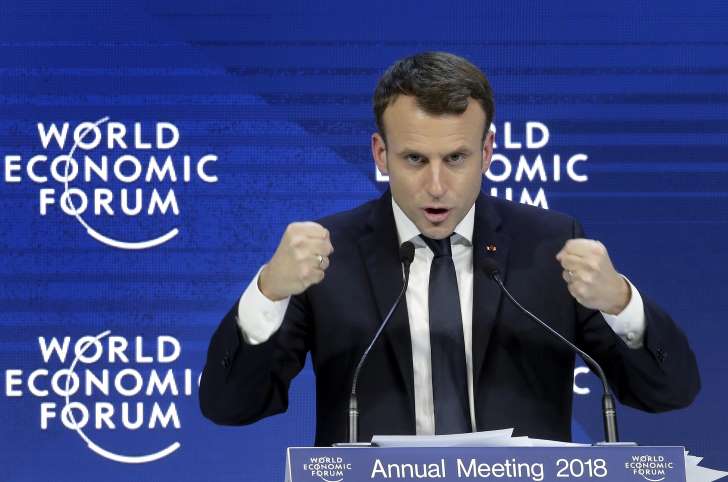
Emmanuel Macron, President of France, gestures during a special address as part of the annual meeting of the World Economic Forum in Davos, Switzerland, Wednesday, Jan. 24, 2018.


Among the many casualties of Europe’s decade-long economic crisis was a sense of collective purpose among the region’s leaders. The downturn was exacerbated by the unique defects of the euro — a shared currency that operates without a joint budget or political agreement among member states.

Mr. Macron has devoted his first months in office to arguing for the creation of a shared eurozone finance minister along with euro-wide budgets, enabling better coordination of economic policies when crisis returns.
Ms. Merkel has expressed cautious support while assiduously avoiding blessing anything that smacks of transferring German wealth to the less prosperous countries of the Mediterranean — a radioactive proposition among German voters.


Emmanuel Macron, the president of France, spoke forcefully at the World Economic Forum Wednesday on advancing European integration, while defending the notion of international cooperation.


The German chancellor has in recent weeks grappled with complex negotiations toward forming a coalition government composed of her Christian Democratic Union and the more left-leaning Social Democratic Party after inconclusive elections last fall.

Many analysts have assumed that political fragility in Germany would complicate Mr. Macron’s efforts to win German support for his integration proposals. But the coalition taking shape would bring a more pro-European orientation, many analysts say.
“I came here thinking about the fractured world, and one day later I feel I’m in a converged world,” said Charles-Edouard Bouée, chief executive of Roland Berger, a global consultancy with offices in Shanghai and Múnich.


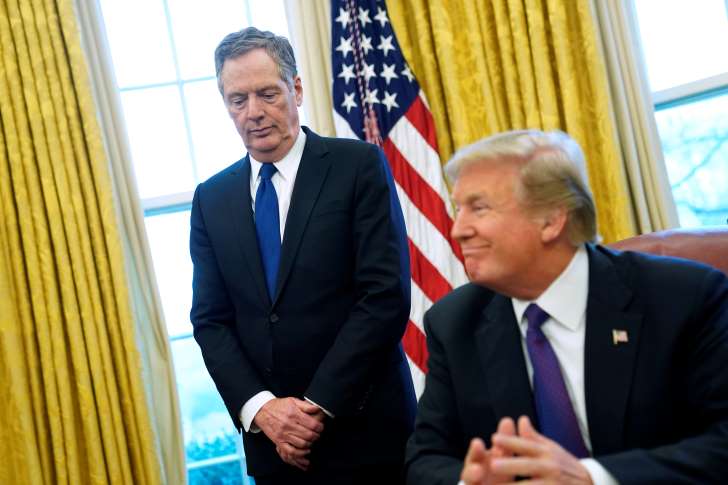
U.S. Trade Representative Robert Lighthizer stands behind U.S. President Donald Trump as Trump prepares to sign directives to impose tariffs on imported washing machines and solar panels in the Oval Office at the White House in…


In her speech here on Wednesday, Ms. Merkel reaffirmed her commitment to completing a so-called banking union, a system that shares the risks of financial breakdown across national borders.

She cast the drive to better integrate Europe as a historical responsibility of grave import, noting that the concept of the European Union dates back to the effort to limit future bloodshed in Europe by building economic ties.
“We have to ask ourselves, when we have fewer and fewer people who remember these events of history, have we learned the lessons of history?” Ms. Merkel asked.
“Many people seem to worry, will multilateralism find an answer to the problems that mankind has in a fair and equitable way?” Ms. Merkel said, seemingly referring to Mr. Trump. “We think that shutting ourselves off against the world, isolating ourselves, will not lead to a good future. Protectionism is not the right answer.”

“We must not give in to the idea of a world destined to be split between a cosmopolitan digital elite and an army of precarious and underpaid local workers,” Paolo Gentiloni, prime minister of Italy…


For years, Italy has been the face of Europe’s most deep-seated problems: its banks stuffed with terrible loans, its communities full of young people who have moved in with their parents for lack of jobs.

But even Italy is now sharing in Europe’s economic expansion, though joblessness remains rampant. The country’s prime minister used the stage here to argue that now is the moment to attack economic inequality. Either that, or the forces of populism will triumph, he warned — a clear worry about Italy’s approaching national elections, and the ascendant Five Star party, which has been hostile to the euro.
“We must not give in to the idea of a world destined to be split between a cosmopolitan digital elite and an army of precarious and underpaid local workers,” Mr. Gentiloni said. “This worry, and these frustrations, are our main concern.”
These sorts of mission statements are increasingly dominating the political conversation in Europe — nowhere more than in France, where Mr. Macron, a former investment banker, has pledged to make his country more appealing to business while strengthening unemployment benefits and training for castoff workers.
The centerpiece of Mr. Macron’s efforts are the labor reforms he introduced last summer, making it easier for employers to terminate workers. In his speech here, he cast that not as a means of relinquishing labor to the unsentimental winds of capitalism, but rather giving start-up companies relief from the strictures of national labor contracts negotiated by unions.
Employers have in recent weeks used their newly acquired authority to fire to do just that, while the supposed Nordic-style worker protections Mr. Macron has promised have yet to materialize.
Mr. Macron promised to fill the void, vowing to spend 15 billion euros — about $18.6 billion — over the next five years on education and retraining.
“If I cannot explain to people that globalization is good for them, and that it will help them develop their own lives, then they will be the nationalists, the extremists who want to get out of the system,” he said. “And they will win in every country.”


How often should we shower, according to science?

The internet (like Siri) has become an oracle to which millions of people turn every day hoping to resolve their countless doubts. Google kn...