We’re not joking! The idea of a luxury Citroën 2CV seems incongruous, but it’s what we have here. Not only that, but we’re talking of a model that was only made for a matter of months – making it a sought-after rarity.
Farmyard fashion? Why, though, did Citroën decide to doll-up the ‘Deuche’ with a sparkle of glamour so at odds with the car’s utilitarian image? The answer isn’t hard to find.
Chasing the competition In October 1961, Renault had introduced its R4. In its first full year, sales came within a whisker of those of the 2CV – and in 1963 they would pull ahead. The notion that Renault sold its small cars – 4CV and Dauphine – to townies and left the rural market to the 2CV was brusquely knocked on its head. Not only that, but the new Renault had a dual town-and-country appeal thanks not just to its better performance, but also to its availability in more luxurious forms.
Affordable luxury Citroën had to react, and in March 1963 it came out with the AZAM – an AZ (a 425cc 2CV, in other words) that had been améliorée or ‘improved’. Mechanically the car was unchanged, meaning that the air-cooled flat-twin still developed 18bhp, and remained mated to a four-speed gearbox with the option of a centrifugal clutch. But the equipment list was long – and that was the point of the new model.
Sparkle and polish Outside there were Ami 6 hubcaps, stainless-steel front window frames, bright trim for the windscreen and the rear-door windows, a polished aluminium bonnet strip, stainless looped overriders, half-moon doorhandles, and chromed headlamp rims and wiper arms. Marvel of marvels, there was even a second brake light for the first time on a 2CV.
Are you sitting comfortably? Inside, the key changes were better-upholstered Ami-like seating, with a sliding front bench (the car pictured has the optional separate front seats), plus a more styled Quillery steering wheel and a rear parcel ‘trench’. Other details were black plastic lock handles, an interior light, a passenger sunvisor (with mirror), and a column indicator stalk.
Better to drive, too In December 1964, the 2CV’s rear-hinged ‘suicide’ front doors gave way to front-hinged items, to conform with French legislation, and in September 1965 the AZAM, in common with other 2CVs, gained the familiar six-light body style with its revised radiator grille. More significantly, driveshafts with constant-velocity joints became standard on the AZAM, eliminating the snatch when pulling away under lock that previously blighted drivability. In this form the model lasted until April 1967, when it was replaced by the AZAM Export.
More go to match the show All the while, the engine remained at 425cc – whereas from January 1965 the Belgian assembly plant savvily offered an AZAM 6 with the 602cc engine of the Ami 6, along with 12V electrics and CV-jointed driveshafts. The Spanish factory in Vigo would later list a similar model, lasting until 1972. Quite why the French were never offered a 602cc AZAM remains a mystery.
Did it make the difference? If we’re honest, all this stuff was pretty much smoke and mirrors. A few strips of brightwork didn’t make for a better car. The standard 2CV ‘hammock’ seats were perfectly comfortable, and the CV-joint driveshafts could be specified on lesser 2CVs.
Ready to move on? Members of the press were unmoved. Period French road tests of the six-light AZAM didn’t deem the supposed enhancements of the model even worth mentioning. The 2CV was a car whose time had passed; that was the message. The Citroën was judged crude, poorly finished and above all miserable to drive, due to its lack of performance. It was time to put it out of its agony.
Sales success The public thought differently: there was enough loyalty to keep sales stable, with even the odd tick upwards. But the R4 was powering ahead: in 1967, 321,079 were produced, against 201,679 of the 2CV family, Ami 6 excluded. The answer was to emerge with the announcement of the Dyane in autumn 1967, ahead of which the AZAM Export was deleted from the price list in August.
A new lease of life The ‘new 2CV’ was initially just a crisp, fresh suit of clothes over the old mechanicals. But once it was given the option of the 602cc engine, in January 1968, the hatchback Dyane answered many of the criticisms aimed at the 2CV, which it came briefly to outsell by almost two-to-one. It was only with the availability of the same unit from February 1970 that the 2CV came bouncing back, forming a successful double act with its supposed replacement – which it ended up outlasting.
Ticking the boxes The 1970-on 2CV6 included some items of AZAM equipment, but above all it had an engine that gave the car the modern-day usability it had previously lacked. That 602cc powerplant was the real game-changer. An output of 28.5bhp constituted a 58% increase on the AZAM’s 18bhp – no small matter. In retrospect, the AZAM was low-cost marketing flim-flam that achieved very little.
A 2020 perspective Today, of course, we look at the model with different eyes, appreciating it for its unique quirks of presentation – especially in the case of the Export, whose owners will proudly point out, for example, the chrome ring on the ex-Ami gearknob. Good survivors of this five-month wonder are scarce, and rare are those that have original upholstery in presentable order and a full set of undamaged ‘Gala’ wheeltrims. The AZAM Export of Hervé Chauvin was bought in June 1967 by his grandmother, whose only previous car had been a more basic AZL, and passed to Hervé and brother Francis in 1995. With just 70,000km on the clock, it has its original hood and seats, which in the front are the optional separate type.
Better than the average It had a respray in the correct Gris Rosé in 2004, and can be regarded as a fine, untampered-with specimen of the breed. And, yes, it does look smarter than a bread-and-dripping standard 2CV. Those bits of brightwork give it a lift, the orangey-red upholstery looks plush, and the dashboard less as if it’s been ripped from a passing tractor. There really is a bit of jauntiness to the old girl. And to drive? Here there are no surprises. “It’s a bit limited in speed. It’s fine for Sunday pottering but not really suitable for everyday use,” cautions Chauvin as I sink – slump? – into the softly upholstered driving seat and the car gently keels over. Yup, it’s a 2CV all right.
You’ve got to roll with it There’s the usual lolloping ride – even though for 1966 the 2CV had been given telescopic dampers at the rear, while retaining its inertia and friction dampers up front. Until you’ve got the hang of it, profiting from the centrifugal clutch demands concentration, but it allows you to trickle along or pull away from below 1000rpm without touching the pedal. Performance is leisurely, to put it kindly. You really do need to keep the engine on the boil – that usual 2CV combat-driving technique. But the brakes are fine and so is the steering, now there’s no fight through the driveshafts. I’d still vote for a later 602cc 2CV, but I can see the appeal of a ’60s model that tries – ever so gamely, but not totally convincingly – to be lipstick-smart rather than boots-and-pitchfork rustic. As for Chauvin, would he ever sell his family AZAM? “No. Absolutely not!”
The Blower resurgence project is led by experienced Mulliner engineer Glyn Davies
Imagine you’re one of 12 people who’ve already laid down £1.5 million-plus to own one of Bentley’s magnificent ‘continuation series’ 1929-style 4.5-litre Blowers. You’ve already bought your car, but it’s just four months into a two-year gestation and very little of it yet exists. But later this year Bentley Motors’ bespoke car operation, Mulliner, will ask you to decide some vital details of your car’s specification – and one in particular will entail a bizarre but crucial choice.
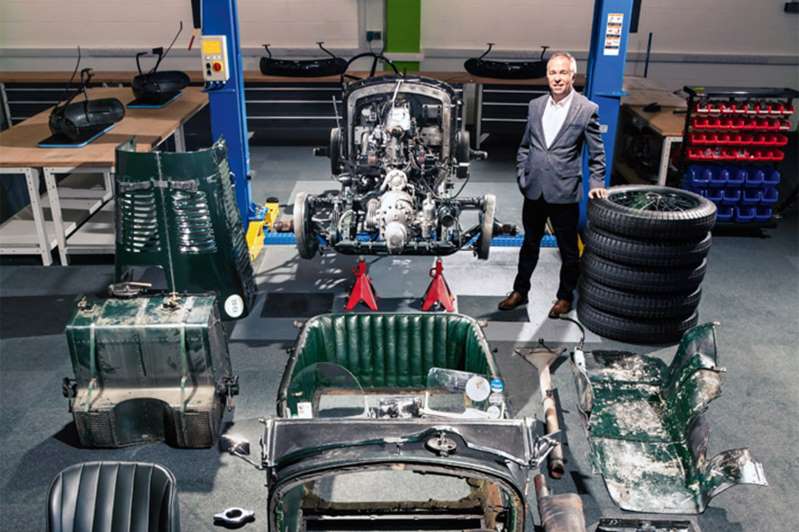
Your car is going to be a perfect, reverse-engineered replica of one of the four special racing Blowers built by Sir Henry ‘Tim’ Birkin, greatest of the pre-war Bentley Boys, chosen to make a racing team from a homologation batch of 50. Bentley has already begun dismantling ‘Team Blower’ No2 to provide data for this exotic exercise. Pretty soon they’ll be assembling hardware.
Every part of the original Blower is being digitised
Then the key question: do you want your car’s floorboards to show wear marks from the racing boots of Birkin and Co who drove these cars in period? Or do you want them flat and pristine? Either option is available: so microscopically accurate is the digital measuring process used to create the 12 new customer cars that you can have an authentic, Birkin-heel-sized depression in the wood beside the base of the accelerator, created 90 years ago by exuberant use of the pedal. It’s one of a number of tiny choices you’ll make as your car’s build proceeds, but perhaps the one that puts you closest to history.
Although generally agreed to be the most famous Bentley of all, the 4.5-litre Blower was a model the company’s famous founder couldn’t abide. WO Bentley’s theory was that to make the car go faster you gave it a bigger engine – a theory proved by the fact that the 6.5-litre Speed Six did much better in competition than the Blower. But Birkin, who moved in the same circle as the supercharger designer Amherst Villiers, was keener on the Blower concept (which boosted power from 175bhp to 240bhp). He won the approval of the ailing company’s chairman and backer, Woolf Barnato, against WO’s opinion. The company built 50 Blowers, plus four for Birkin to modify and race, one of which was the No2 Team car in our pictures, still owned by Bentley Motors.
Original Blowers were idiosyncratic, with many forged using differing steel grades
The Blower never won a race in its heyday and only entered 12 events (hence the continuation batch’s size), but Bentley folklore credits the Blower with a key role in a Speed Six’s win at Le Mans in 1930. The tale was that Birkin’s Blower ran so hard from the start that it “exhausted” Rudolf Caracciola’s solitary 7.0-litre Mercedes SSK, the biggest threat to a Bentley victory. Barnato’s Speed Six then took the win. But it’s likely that Birkin so badly wanted to beat Caracciola that he drove his Blower past the limit of reliability. Bentley benefited in any case, taking its fourth successive Le Mans victory.
The devil is in the detail: nut, bolt and grommet recreation requires a part-by-part dismantling of ‘No2’ to get everything just right
The Blower continuation project has been based since September at Envisage, the high-tech car creation consultancy on the outskirts of Coventry. The project’s leader is a hugely experienced Mulliner engineer, Glyn Davies, who is using a mystical combination of 2020s digital measuring equipment and his own experienced eye for old cars to decide exactly what the continuation models will be like. Once all digital information has been garnered from No2, operations will return to Mulliner HQ at Crewe, where the 12 new Blowers will be built.
The first Geneva motor show took place in 1905.
This year's extravaganza opens to the press - Coronavirus permitting - on Tuesday March 3rd and to the public two days later. It will be the 90th running of an event that's undoubtedly one of the highlights of the international motoring diary.Over the past 115 years hundreds of concept cars have made their debut in Switzerland, some brilliant, some not so much. Here we take a look at 50 of the best, starting in 1960 when the concept car really started to gather momentum:
Davies is a Mulliner ‘lifer’ who started as a sheet metal apprentice in the 1970s, working in Crewe’s experimental department where prototypes were made by hand. He later trained as a mechanical engineer and became a Mulliner project leader, usually deployed on difficult, secret and low-volume projects. Until this gig, his greatest achievement was the successful recreation of a one-off 1939 Bentley Corniche saloon concept destroyed during the war, and the rebuilt car played a large part in Bentley’s recent centenary celebrations. Retirement was supposed to follow, but then the Blower project came along.
In theory, producing 12 matching replicas of a pre-war racing car from an authentic original sounds straightforward if you have the skills. Equipped with modern software, you digitise everything using the dismantled original car to decide authentic components. You decide whether existing restoration parts can help (there’s already a lively Bentley restoration industry) and then you start building. But it’s turning out to be much tougher than that.
Advertisement
“I assumed the Blowers were all the same,” he says. “All built on the same standard chassis. But they’re not. The Birkin cars were built separately, and they use 5.3mm steel for chassis members, not the standard 4.2mm. And whereas original cars used hot rivets to hold their chassis together, the Birkin cars had bolts. Our lab has confirmed that even the steel grades are different. Luckily we’ve identified a modern steel with very similar tensile strength and hardness, but it’s the kind of problem we didn’t expect, and there are others.”
Davies and his handful of helpers (“a small team is the beauty of this project”) have almost finished scanning and are now well into choosing materials while fussing over tolerances and deciding weird issues such as whether to replicate engine louvre mods made hurriedly in a race paddock 90 years ago. And then there’s which supercharger to use. “Every time we see a picture, it looks different,” Davies says.
Aside from such decisions there’s the job of sourcing non-existent materials, such as No2’s dashboard lap counter ‘liberated’ from a Paris billiard room or the cockpit’s array of Victorian light switches. There are sets of imperial bolts and nuts to be found and magnesium alloy bulkheads (each car has two) to be recreated in the correct material. Rexine, the body covering and trim material, isn’t the problem it might have been: a far-sighted Bentley enthusiast acquired rights to it when ICI stopped making it years ago.
Suddenly this programme’s two years seem no time at all. And you see why it’s so vital such a task could only fall to one of the world’s proven experts. Whisper this, but even the £1.5 million-plus price tag on these new-age Blower Bentleys looks like a bit of a bargain.
Catalonia's former regional president Carles Puigdemont, left, and former Catalan regional minister Antoni Comin take a selfie overlooking the plenary chamber at the European Parliament in Brussels, Friday, Dec. 20, 2019. In a potentially stinging reversal for Spanish justice authorities, the European Union's top court ruled that a former Catalan official serving a prison sentence for his role in a banned independence referendum two years ago had the right to parliamentary immunity when he was on trial.
A Spanish Supreme Court judge asked the European Parliament on Friday to strip the Catalonia region's ex-leader and another fugitive Catalan politician of the legal immunity they have as EU lawmakers.
The European Parliament said in Brussels that the two would be officially welcomed at the legislature's plenary on Monday but added that another Catalan MEP could not be sitting as an EU legislator because it had to take note “without delay” of a ruling this week of the Spanish supreme court. It did not elaborate.
Spanish investigating Judge Pablo Llarena also upheld the European arrest warrants Spain issued for former regional president Carles Puigdemont and for Toni Comín, who was a member of his Cabinet.
European Parliament President David Sassoli said Friday that Puigdemont and Comin will be confirmed when the plenary session opens on Monday in Strasbourg France.
Puigdemont's pro-secession government led a drive to break Catalonia away from Spain two years ago. He and Comín fled to Belgium in October 2017, days after the regional Catalan parliament passed a unilateral independence declaration.
Both won election in May to the European Parliament, along with Puigdemont's former No. 2, Oriol Junqueras. Members of the European Union's legislature have immunity from arrest, detention and prosecution.
Sassoli said that Junqueras had to be denied his place based on a Spanish court decision on Thursday.
After the EU's top court ruled against Spain's move to block the trio from taking their seats, they were accepted as MEPs.
Junqueras and several other members of Puigdemont's Cabinet remained in Spain and spent nearly two years in pretrial detention for their roles in the secession attempt. He was convicted of sedition and is serving a 13-year prison sentence in Spain.
Puigdemont, Comín and several other politicians fled the country and have thus far successfully fought extradition. Outstanding arrest warrants, including national ones, mean they would be immediately detained if they attempted to return home.
NASA’s Juno orbiter has captured stunning images of the swirling, hypnotic beauty of Jupiter in the three years it has been observing our solar system’s largest planet.
On Sept. 12, Juno sent back a scene from a close orbit of 8,000 kilometers. Data processed into a color image shows Jupiter’s moon Io casting a shadow over the planet.
While eclipses are commons for Jupiter, which has at least 67 known moons, the image stunningly showcases’s the planet’s massive scale. Io, roughly the same size at Earth’s moon, blocks out only a minor portion of Jupiter’s full surface area.
1. Massachusetts Institute of Technology (MIT), Cambridge, US
Students: Over 11,000
Acknowledged as an educational behemoth, MIT has built a strong academic reputation with courses on architecture, engineering, technology and the social sciences, among others.
2. Stanford University, California, US
Students: Over 16,000
Comprising 18 interdisciplinary research institutes and seven schools, the university is known for its traditional liberal arts courses as well as its technology and engineering programs.
3. Harvard University, Cambridge, Massachusetts, US
Students: Over 22,500
America’s oldest university is known for its humanities and natural sciences courses. Like several other high-ranking institutes, Harvard's alumni network is populated with Pulitzer Prize winners, Nobel laureates and heads of states.
4. California Institute of Technology (Caltech), Pasadena, US
Students: Over 2,000
Caltech is one of the top institutes in terms of education and research in science and engineering. It also offers opportunities for study in fields like music, theater and the visual arts.
5. University of Oxford, England
Students: Over 20,500
One of the most storied universities in the world, Oxford has four academic divisions - Humanities; Mathematical, Physical and Life Sciences; Medical Sciences; and Social Sciences. Its alumni network comprises Olympic medalists, Nobel laureates and world leaders.
6. University of Cambridge, England
Students: Over 19,000
Founded in the early 13th century, Cambridge is prized for its centuries of historical importance. It has over 100 libraries that house more than 15 million books, in addition to magical museums and a botanical garden.
7. ETH Zurich - Swiss Federal Institute of Technology, Switzerland
Students: Over 18,000
ETH Zurich has a strong background in scientific and technological research. It has produced over 20 Nobel laureates, including theoretical physicist Albert Einstein (1879-1955).
8. Imperial College London, England
Students: Over 16,500
The institute offers science, engineering, medicine and business courses, with an added focus on the practical applications of research.
9. University of Chicago, Illinois, US
Students: Over 13,500
With 29 Nobel laureates to their credit, this research-focused university has a strong academic background. Its professional schools include the Pritzker School of Medicine, the Booth School of Business and the Harris Public Policy School.
10. University College London (UCL), England
Students: Over 32,500
A highly regarded multi-disciplinary university, UCL boasts a diverse student body and over two dozen Nobel laureate graduates.
11. National University of Singapore (NUS), Singapore
Students: Over 30,000
Singapore’s flagship university, NUS take an Asia-centric approach to its multidisciplinary curriculum. It has 30 university-level research set-ups that focus on fields like energy, environment and risk management.
12. Nanyang Technological University (NTU), Singapore
Students: Over 25,000
This research-focused university is frequently listed among the world’s most beautiful ones. Its multicultural campuses are home to globally renowned organizations like the Earth Observatory of Singapore and the National Institute of Education.
13. Princeton University, New Jersey, US
Students: Over 8,000
One of the oldest universities in the U.S., the private university counts two U.S. presidents (James Madison and Woodrow Wilson) among its graduates, as well as Amazon CEO Jeff Bezos, among others.
14. Cornell University, New York, US
Students: Over 22,000
The Ivy League university has academic units in Ithaca, New York City, New York, and Doha, Qatar. In addition to offering courses across diverse disciplines like veterinary science, journalism and the biological sciences, the university also hosts more than 1,000 student organizations.
15. Yale University, New Haven, Connecticut, US
Students: Over 12,500
Known for its law and legal studies, history, politics and humanities courses, the university has over 100 departments and programs to cater to all kinds of student interests.
16. Columbia University, New York, US
Students: Over 26,000
The private university is formed of undergraduate schools, like Columbia College and the School of General Studies, and graduate schools such as Columbia Law School and Columbia Journalism School. It also boasts 83 Nobel Prize laureates.
17. Tsinghua University, China
Students: Over 36,000
The Beijing-based university comprises 20 schools and 58 departments that teach a variety of courses like science, engineering, arts and literature, social sciences and medicine.
18. University of Edinburgh, Scotland
Students: Over 39,000
With more than 500 undergraduate and 300 graduate programs, the multi-disciplinary university fosters a dynamic research culture.
19. University of Pennsylvania, Philadelphia, US
Students: Over 20,500
Founded in 1740, this is a private Ivy League institute with a storied reputation. Its four undergraduate and 12 graduate schools offer courses in the liberal arts and sciences.
20. University of Michigan, Ann Arbor, US
Students: Over 43,500
The university's reputation is bolstered by research-oriented graduate programs and professional degrees, as well as its nearly 1,500 societies and club.