Es mostren els missatges amb l'etiqueta de comentaris historia. Mostrar tots els missatges

dissabte, 29 de maig del 2021

Expeditions that changed the course of history

North America, South America, Asia, Africa, Australia: these were all once lands untouched by Europeans. The day that men set off to explore the world changed everything for everyone.

The period between the 15th and 18th centuries, perhaps wrongly named the Age of Discovery despite the fact that many of the lands were already inhabited, saw Europeans spread across the globe. Even after these impactful explorations, humans have continued to adventure to faraway places, even to the sky and the Moon.

From Columbus to Armstrong, here are the most important expeditions that changed the world.

Mount Everest

They took 350 porters and 5 tons of baggage on the adventure! When they finished, Hillary's best friend was waiting at the bottom with hot soup for them. Rightly so!


Edmund Hillary (1919-2008)

In 1953, Edmund Hillary and Tenzing Norgay were the first men to reach the top of Mount Everest, the highest mountain in the world. Hillary is credited most with the achievement because he placed his foot on the summit first.

Roald Amundsen (1872-1928)

Amundsen was an incredible explorer of the coldest regions on Earth. In 1897, he set off to find the Northwest Passage, which is the route that connects the Pacific and Atlantic oceans to the Arctic Ocean. Explorers had been looking for it for years.

Discoveries

Roald Amundsen went further than just the Northwest Passage. He was the first man to reach the South Pole and to fly over the North Pole. Therefore, he was the first human to conquer the most uninhabited areas in the world.

Christopher Columbus (1451-1506)

We all know of Columbus. He was supposedly the first man ever to cross from Europe to South America.

Where did he go?

In 1492, Columbus was looking for a quicker way to get to India. Accidentally, he ran into Latin America. In his life, he made three trips over the Atlantic Ocean for further exploration of the 'new' land. It is said that Columbus made the first connection that led Europe to colonize Latin America.

Charles Darwin (1809-1882)

The famous scientist was also an explorer in his own right. Darwin had been studying biology at Cambridge when he was asked to go on an exploration voyage on the HMS Beagle.
The Galapagos

Charles Darwin then spent five years traveling around South America recording species, habits, and environments. He focused his research on the Galapagos Islands. All of the research was used to create the controversial book 'On the Origin of Species' (1859).

David Livingstone (1813-1873)

In the 19th century, Africa was a pretty mysterious place for most outside the continent. David Livingstone set out to explore the continent and get to know its cultures. He arrived there in 1865.

Missing?

While Livingstone was trekking through Africa, he also sought to find a way to halt the slave trade because he could see the damage it caused. Originally, he was meant to return after two years, but instead he stayed until his death. The British, meanwhile, thought he had gone missing.

Meriwether Lewis (1774-1809) and William Clark (1770-1838)

Lewis and Clark's expedition was to survey and charter the West of the United States. It seemed like a simple job, but they had no idea how big the mission they had taken on would be.

The West

After an astonishing 8,000-mile (almost 13,000-km) trek, the Corps of Discovery reached what is now Oregon. Their way back was very difficult, as they encountered Native Americans who attacked them. On their return, they were hailed as heroes by President Thomas Jefferson and the people.

Neil Armstrong (1930-2012)

We need hardly tell you what happened here! On July 20, 1969, Neil Armstrong successfully undertook the mission to land on the Moon.

"One small step for man"

Armstrong's expedition made human’s dreams of space a reality. It was the first direct connection with another land in outer space, but was by no means the last.

Amelia Earhart (1897-1937)

In 1929, history was made when the first female aviator crossed the Atlantic Ocean. Incredibly, she was only the 16th woman in the world to have obtained a pilot's license.

More to it

Earhart was also the first person in history to ever fly over both the Pacific and Atlantic oceans. The aviator's life is shrouded in mystery, however, as she disappeared in 1937 and was never seen again.

Zheng He (1371-1433)

During the Ming Dynasty, Zheng He explored the world in totality. The Emperor bid him to show the greatness of the empire to other countries. With this aim, he went on seven expeditions!

Did Columbus do it?

By recording where they went, Zheng He was able to make a map of their expeditions. As you can see, there is an America. This map was created years before Christopher Columbus hit the seas. Contrary to our history books, it's very possible that the Chinese came across the Americas before the Europeans.

Amerigo Vespucci (1454-1512)

Does that first name look familiar to you? America was named after Vespucci because of his exploratory success. In 1497, he sailed from Spain to South America, and was convinced he had discovered a new continent.

The rios

Even though he was wrong about the new continent as it had already been visited by a few others, his explorations put Rio de Janeiro and Río de la Plata on the map.

John Cabot (c. 1450–c. 1500)

In 1497, this burly man led a voyage across the North Atlantic Sea and stumbled across Canada. He originally thought that Canada was Asia, which is why he planted a British flag on it.

Disappearance

Born in Italy, Cabot dedicated his life to exploration and was set to return to Canada. In 1498, he set off again with a fleet. But John Cabot never returned. No one knows what happened to him and his ships.

Hernán Cortés (1485-1547)

Many will know of the Conquistador Cortés. He left Spain at the age of 19 to explore the world and decided to conquer the Aztec Empire in Mexico.

The Aztec Empire

Here you can see a depiction of Córtes talking to the Emperor of the Aztecs. But there was not that much talking done in reality. Brutally, Córtes and his men killed over 100,000 indigenous people, but many more died of illnesses that the Europeans brought over.

Francis Drake (c. 1540–1596)

Francis Drake was a great friend of Queen Elizabeth (1533-1603). He is famous for sailing around the whole world and claiming California for the British Empire.

Virginia

The Queen liked him so much that she did not let him go off and explore the Americas more, but he found other ways to do so. Drake invested in an expedition that ended up claiming Virginia. Its name comes from Queen Elizabeth's nickname, the "Virgin Queen."

James Cook (1728-1779)

At the age of 29, Cook was already the master of a ship. In 1770, he endeavored to explore the Pacific and Australia.

New Zealand and Australia

On his voyage upon the HMS Endeavour, he gathered information on New Zealand, the Great Barrier Reef, and Australia. Importantly, he proved that Terra Australis, the hypothesized continent, did not exist.

Ferdinand Magellan (1480-1521)

Magellan organized an expedition to explore the East Indies in 1519. However, more notable than the expedition is that he circumnavigated the Earth.

Around the world

The voyage was treacherous. Of the five ships that set off from Seville, Spain, only one returned. Magellan, along with 251 men on board, died before the expedition ended.

dissabte, 20 de març del 2021

Alaska, a wasteland that Russia did not hesitate to sell

The signing of the cession treaty of Alaska on March 30, 1867

In 1867, the Finn T. Ahllund ignored the advice of his comrades and agreed to work for the Russian-American Company in Alaska, then part of the Russian Empire. He and 47 other rookies set out, like this, for "the Siberia of Siberia."

Upon their arrival in New Archangel, they were brought before the governor, Dmitri Petróvich Maksútov, who awarded them the jobs and showed them their barracks. Ahllund was not impressed with his bedroom, an austere room that he had to share with fifty other people, and with an obvious sanitation problem.

On a visit a few years earlier, Britain's George Simons said that the town had seemed "the most miserable place he had ever visited." In addition, a diet without fruits or vegetables, based on dried fish and a rather scarce meat, made scurvy a constant, with deadly outbreaks in 1805 and 1821.

To make matters worse, almost at the gates of New Arcángel lived a hostile indigenous village, the Tlingit, then in a fragile truce. On one of his escapades beyond the palisade, Ahllund was able to witness the legends he had heard about her harshness. Otherwise, with their painted faces and piercings in their lips and ears, they seemed enormously enigmatic people.

New Arcangel in 1863

One night he saw a naked child being plunged into the icy waters of the Bering Sea, then his shivering body was whipped with a riding crop. The shaman's blows, intended to activate blood flow, were the only thing that kept the little boy from dying of hypothermia.

Not all tribes enjoyed the same freedom as the Tlingit. Driven from their native archipelago, the Aleuts were forced to hunt furs for the Russian-American Company.

Whether it was due to the abuses suffered or the mixed marriages, fully naturalized, the relationship between Aleuts and colonizers ended up giving birth to a generation of Creoles. As explained by Claus-M. Naske and Herman E. Slotnick in Alaska, a history of the 49th state (1979), this is because Russians at the time did not attend to differences in race.

In fact, it was common for indigenous people to get drunk alongside Europeans on the many days off offered by the orthodox calendar, full of saints. For Ahllund, that was practically the only good news he'd had since his arrival. Perhaps then he understood why there were rumors that the tsar was going to sell a colony that, in the last hundred years, had barely progressed.

Tsar Peter the Great

It all started in 1725, when Tsar Peter the Great wanted to know what lay beyond the limits of his vast empire, and commissioned the Danish sailor Vitus Bering to explore the northwestern coast of North America. After a difficult journey through Siberia, he and his men reached the Kamchatka peninsula, ready to enter waters hitherto unknown to any European.

After a first unsuccessful attempt, they reached Alaska in 1741. They stayed there for a short time, the time necessary for Dr. Georg Wilhelm Steller, the expedition's naturalist, to collect some remedies to cut the outbreak of scurvy from the ship San Pedro.

As he himself regretted, they had invested ten years of their lives preparing an exploration that only lasted ten minutes. On his return, Bering ended up dying on an island, which, like the strait that separates the two continents, today bears his name.

The promyshlenniki

Due to the neglect of St. Petersburg, in the early years the colonizing task was left in the hands of the promyshlenniki, Siberian hunters attracted by the Bering stories. They hunted sea otters in the Aleutian Islands, and when they became extinct there, they continued eastward into North America. Being men who traveled alone, the majority illiterate and inclined to drink, they ended up enslaving the native Aleuts.

But, probably unknowingly, the promyshlenniki had caused an earthquake thousands of miles away. In Madrid, Carlos III received with disgust reports of the growing Russian presence on the northwestern coast of North America. After all, since 1494, the Treaty of Tordesillas gave him full sovereignty over the American Pacific. The time had come to make that right effective.

On January 24, 1774, the ship San Blas left New Spain heading north. Her mission: to know the extent of the Russian advance. Under the orders of the Mallorcan Juan José Pérez Hernández, they sighted Vancouver and reached a strait that they called the San Lorenzo surge.

But, determined to find the Russians, they ignored another threat. Unbeknownst to them, in 1778, the legendary British sailor James Cook had reached the rise of San Lorenzo and renamed it Nutka. As soon as they heard that news, Captains Esteban José Martínez and Gonzalo López de Haro set out again for Alaska to establish a settlement before the English.

Too late. Upon reaching Nutka, Martínez discovered that a ship in the service of the British Crown was already anchoring in those waters. He decided to seize it, and later secured the position by building a fort which he called San Miguel. If that incident did not end in an open war between the two powers, it was because of the weakness of Spain.

Without the support of France, immersed in a revolution, and in frank decline in America, the Hispanic Crown had to end up yielding. In 1794 Nutka was handed over to the British. Today only the nomenclature of some places recalls the Spanish past of Alaska, such as the Malaspina glacier or the cities of Cordova and Valdez.

The withdrawal of the Spanish made things easier for Grigory Shélijov, a Russian merchant who wanted to turn the small fur economy of the promyshlenniki into a large-scale business. His business prospered so much that, in 1799, Tsar Paul I gave him a monopoly on all trade in Alaska. The Russian-American Company was born.

Aleksánder Baránov

That fell like a stone on the director of operations in America, Aleksánder Baránov. Despite being a man only interested in obtaining profits for his company, he was now responsible for governing and evangelizing that land.

For Baránov, the immediate problem was the lack of men. Many of his employees were Aleut slaves, ex-convicts, or forced Russian serfs. There was nothing better, since not many Russians were willing to endure the harsh living conditions in the colony.

According to the historians Naske and Slotnick, more than one drunk of those who populated the port of Okhotsk, in Siberia, ended up against his will on the way to Alaska. By the time they woke up from the melopea, they were already on board the ship. With such a group of people, the governor had to resort to severe physical punishment to impose discipline.

Baránov would be fought in the summer of 1805, when his substitute appeared in the port of Nuevo Arcángel. Nikolai Rezanov was a virtuous man, with refined tastes and who, at fourteen years of age, had already mastered five languages. Besides, he did really believe in the colonizing project.

Aleut in a baidarka, the boat used to hunt marine mammals. In the background, a Russian ship. Illustration from 1817

As soon as he arrived, he worried about evangelization, until then in the hands of some Finnish monks who did not even bother to learn the language of the natives. After reprimanding the religious, he began an ambitious project to write a dictionary of indigenous languages, which was to serve to make sermons more intelligible.

Despite certain achievements in sanitation, in the following years the colony would face insurmountable challenges. When Dmitri Petróvich Maksútov assumed the position of governor in 1864, the fur trade, his main source of income, was already in decline.

In St. Petersburg, patience with the American company was running out. The first to speak out was Grand Duke Constantine, the Tsar's younger brother. He saw the United States as an emerging power whose duty it was to claim the entire continent for itself.

And what better way than to take advantage of it, then, to put land in the middle with the British, who, after defeating Russia in the Crimean War (1853-1856), could well invade the Empire from neighboring Canada.

In March 1867, they sat down to negotiate with the American Secretary of State, William H. Seward, a staunch defender of the purchase. At four in the morning of March 30, the sale was agreed for 7.2 million dollars. At today's exchange rate, they would be approximately 132 million.

The check used to buy Alaska for the United States

The price may seem low, but Seward still had to take a lot of teasing because of him. Many criticized the purchase of a territory that seemed sterile to them. With a sense of humor, some media referred to the "madness of Seward", who had invested taxpayers' money to buy a "garden for polar bears."

For Ahllund, the news of the purchase came with the appearance in the port of Nuevo Arcángel of two North American steamers. A column of soldiers descended from these and marched in formation to the governor's house.

There the Russian garrison awaited them, which, at Maksútov's direction, began to solemnly lower their flag. At least they tried, since it got tangled up halfway. It took three attempts to free the post, as if the double-headed eagle did not want to leave America.

dilluns, 1 de març del 2021

3,500-year-old Egyptian papyrus reveals new details about mummification


 A new document found has provided previously unknown details about the mummification process . Researchers have found a 3,500-year-old medical papyrus, which makes it the oldest manual on the process they carried out to prepare their loved ones after death.

Specific research has focused on the Louvre-Carlsberg papyrus , named after its two 'owners': the well-known French museum and the Carlsberg Papyrus Collection at the University of Copenhagen . The papyrus, divided into two parts, originally belonged to two private collectors. Despite the fact that several sections are missing, it has been possible to date around the year 1450 BC , surpassing the other two examples of embalming by more than a thousand years.

In it, new evidence has been revealed regarding the entire process of embalming the face of a deceased in ancient Egypt, in which the face was covered with a piece of red linen and aromatic substances.

Medical text on the use of plants

Formerly, mummification was considered a sacred art whose knowledge was limited to very few people . Hence, according to experts, the secrets could be passed on by word of mouth . The newly found text is the third of its kind, which is also the oldest in the world. In it, reference is made to the medicine of plants and skin inflammations .

Sofie Schiødt, an Egyptologist at the University of Copenhagen , has been in charge of analyzing the document, in which she found "extremely detailed descriptions" of this entire mummification process and of which nothing was known until now in the other two manuals .

New details of mummification

One of these unknown procedures to date refers to the embalming of the face with a remedy made from aromatic substances and binders , which are cooked to form a liquid with which to coat a piece of red linen .

This fabric was placed over the face of the deceased, making a kind of protective layer of aromatic and antibacterial matter . This process was repeated every four days, while the body was covered by cloth and straw dipped in aromatic substances , in order to ward off insects and scavengers.

Despite being the first time these procedures have been revealed, Egyptologists had already examined some mummies whose faces were covered in cloth and resin , which, according to Schiødt, "would be a good fit."

divendres, 29 de gener del 2021

The Octavius, the legend of the ghost ship that was sailing for 14 years


The ghost ship that sailed for 14 years
In the 18th century, the world of navigation began to obsess over a challenge: finding the Northwest Passage . The era of the discovery of continents or lost islands had already come to an end and, at that time, one of the great objectives that remained pending at sea was to find a way that, bordering North America, would connect the Atlantic Ocean with the Pacific by a short route . However, this would require crossing the dreaded Arctic Ocean , where ice and icebergs complicated the mission. Many ships embarked on the adventure without success.

Possibly, the best known case is that of the Terror and the Erebus , two vessels that were trapped in the Arctic ice in 1845 and were not located until 2016. The main problem that this route had was crossing the Strait of Lancaster , a very narrow strip of water that could only be crossed in summer because, at the time when the cold entered , the freezing temperatures turned the water into a block, impeded navigation and ended up causing the ships to be stranded in a desert of icewhere its crew members ended up dying due to the lack of drinking water and food, thousands of kilometers away from any civilized point. It is precisely in this context that the legend of the Octavius ​​appeared.


This schooner would begin its journey on September 10, 1761 , when the ship left London for China . Commanded by Captain Hendrick van der Heul - who was a former general of Captain Kidd - it took several months to reach the Asian country. Once there, he loaded his holdings with the aim of returning to the UK ... but he never did. Several months later, when the ship had not returned to London, inquiries began to try to find out what had happened to it, but no one knew anything at all , only that it had reached its destination and that it had departed back to the British Isles.


In this way, the Octavius ​​disappeared sometime in 1762, but no one had managed to find its trace. In principle, the original route of the ship only proposed a round trip from London to China, with no other objectives than to make a commercial exchange quite common at that time . However, the surprise would come 14 years after the boat had disappeared. It was October 11, 1776, when another vessel, the Herald, was fishing in the North Atlantic when, suddenly, their lookout could observe another boat approaching them.

The lookout told the captain, Alex Warren , what he was seeing, at which point the ship's chief executive tried, unsuccessfully, to discover which ship it was. His surprise came when he observed that it was a schooner, a rather unusual boat for the area, as it was a boat with three masts and numerous sails that it was not very common to see in an area where cold and ice were common. Thus, the general decided that his ship would approach, but when they shouted from the deck, they received no response. It was a bad omen for the crew, as 'National Geographic' says .

Practically beside him, both Warren and the rest of the crew could see that a good part of the deck of the ship was frozen , with the hull badly damaged and with broken sails. Thus, they decided to send a small advance on a barge to see up close what had happened. When they arrived at the ship, those fears came true: the 28 sailors who made up the crew were lying on their bunks , covered by numerous blankets, but all of them died from frostbite. They then went to the pantries, where they saw that all food and water supplies had been depleted.

Before leaving the ship, Warren went to the captain's cabin in search of the log book, where some explanation of what had happened could be given. But in that cabin there were four more bodies: a woman hugging her son, a man with a flint and a metal bar, and the captain himself, sitting in a chair in front of his logbook, still with his pen in hand . In view of what had happened, the captain ordered one of his men to pick up that little book to analyze it more calmly from the Herald itself, setting that advance party towards his ship.

But the surprises were not over. When the captain carefully reviewed the notebook, he discovered that it only had the first and last pages , but there was enough information in them: the ship was making the route between China and the United Kingdom, but then what was it doing lost there? Indeed, it was the Octavius, something confirmed by the dates in the logbook: the first page had been written on September 10, 1761, that is, the day he began his trip to China and the last one was written on November 11, 1762 , in which he claimed that the ship had been stuck in the ice for 17 days and that the situation was catastrophic.

Or, put another way, the ship they had just found, that is, the Octavius, had been missing for 14 years . Perhaps they had decided to try to find the Northwest Passage on their way home and, even if they did not know it, they had actually achieved their goal posthumously . To this day, experts debate whether the story is real or just a legend, but, be that as it may, it encouraged numerous boats to later try to find the Northwest Passage. It would not be until 1906 when Roald Amundsen succeeded, opening a route that until now had been impenetrable. Except for the Octavius, though his crew never found out.

dijous, 28 de gener del 2021

I’m an Auschwitz survivor – what happened in the Holocaust must never be forgotten


 My name is Freda Wineman and I survived the Holocaust. I start by sharing my name because the Nazis attempted to take that from me. They tattooed me with the number A.7181, they tried to take everything that made me human. They murdered my parents, my brother and countless other members of my family. But I lived to tell my story.

Today is Holocaust Memorial Day. On this day we remember the six million Jewish men, women and children – my friends, family, and neighbours among them – who were murdered simply because they were Jewish. For me the day is especially significant as it marks the anniversary of the liberation of Auschwitz-Birkenau, the place where my life changed forever.  

I was born in 1923, in France. It was a normal, happy childhood with my parents and my three brothers. In 1939, as the Second World War was looming, my entire town near the German border was evacuated and we moved around, settling in St Etienne near Lyon. Life became increasingly difficult, for Jews in particular. In 1944, my mother approached a convent to see if they would hide us. They agreed, but it was too late. We were arrested and sent to Drancy transit camp. 

From Drancy, my entire family was deported to Auschwitz-Birkenau, where we arrived on 2 June 1944. As soon as we arrived, a doctor stood on the ramp and assessed us all to decide who would be sent straight to the gas chambers, and who would be worked for a little longer before being killed. A prisoner came up to us all and started whispering that the older women should take the babies. She told my mother to take the baby of a lady standing next to her – a stranger. She did. She was sent to one side with my brother, Marcel. The baby’s mother and I were sent to the other side. We were told that my mother would be looking after the children, and not to worry. 

A large group of Jews, escorted by soldiers of the SS, are taken to a concentration camp before the eyes of the crowd at the roadside. Berlin, 1934

It was a lie. My mother and my brother were taken to the gas chamber. My mother carried the stranger’s baby with her.  

I was disinfected, tattooed and sent to work. At first, I was digging trenches before being selected to work in the Kanada Kommando – the work unit that was responsible for sorting through the belongings of the new arrivals. We worked in a large warehouse, very close to the gas chambers. I was later sent to dig trenches outside the crematoria, where I witnessed bodies being burnt, all whilst surviving off a daily diet of thin soup made from rotten vegetables and a crust of bread if we were lucky.

In late 1944, I was taken by cattle train to Bergen-Belsen. From there I was sent with 750 other women to Raguhn, a satellite camp of Buchenwald concentration camp, where I worked in an aeroplane factory.  

As the Allies advanced, I was once again put on a cattle train and sent to Terezín in Czechoslovakia where I was eventually liberated on 9 May 1945.  


After liberation, I learned that my parents and my youngest brother Marcel had been killed at Auschwitz.  

Eventually, I was reunited with two surviving brothers. I was lucky, I was no longer alone. I married in 1950 and made my home here in the UK. I have two daughters, six grandchildren, and seven great grandchildren. I survived to share my story today.  

I know I cannot go on sharing forever, but what happened in the Holocaust must never be forgotten. The world should always know what happened to us. 

When I speak in schools I ask students to tell their friends and family what they have heard. I say that in the future, if they ever hear anyone question what happened, they should tell them that they heard Freda Wineman, and she survived the Holocaust. I ask them to be my witnesses. Today, I ask the same of you. Please share my story. Please be my witness.  

dimecres, 30 de desembre del 2020

‘The Battleship Potemkin’, the best movie of all time

 Sergei Eisenstein premieres in Moscow 'The Battleship Potemkin', the film that narrates the revolutionary uprising of the Russian sailors in 1905, considered one of the best films in the history of cinema.

Still from 'The Battleship Potemkin' (1925), massacre on the famous Richeliey staircase

In 1925, on the occasion of the commemoration of the twentieth anniversary of the failed revolutionary coup in 1905, the Soviet government commissioned the young director Sergey M. Eisenstein - who had achieved great success with his first feature film The Strike - to make a film that included those facts.

Eisenstein's initial idea when writing the script was to film the 1905 uprising: on June 27 of that year, the crew of the Potemkin, one of the best battleships in the Russian Black Sea fleet, mutinied because of the harsh conditions of life to which they were subjected. The event became a prelude to the 1917 revolution, setting a precedent in the difficult digestion from the Russo-Japanese War to the uprising against the Tsar.

Filming in Leningrad was interrupted by weather setbacks and the crew moved to the port city of Odessa, where scenes for the film were scheduled to be shot. Once there, Eisenstein changed his mind and decided to focus the script around the mutiny of the battleship Potemkin.

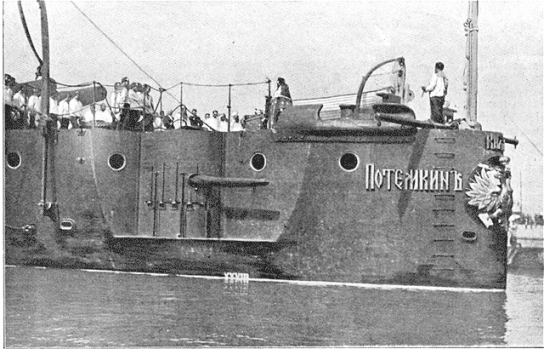
The stern of the battleship in 1905, with its name Potemkin (in Russian, Потёмкин)

The filming took place in just three months, during which time Eisenstein sought testimonies of the event and rewrote the project in five parts: Men and Worms, Drama in the Bay, The Dead Calls for Justice, The Odessa Ladder and Encounter with the fleet.

Filmed with non-professional actors, Eisenstein manages to highlight the expressiveness of the performers in the close-ups and an aesthetic where the exaltation of the group grows stronger as the film unfolds. Thus the sequence of the massacre on the now famous Richelieu staircase –the baby's stroller sliding down the stairs –has been honored by prominent directors such as Brian De Palma in The Untouchables of Elliot Ness or Woody Allen in Bananas.

Filmed with non-professional actors, the expressiveness of the close-ups and an aesthetic where the exaltation of the group is gaining strength as the film unfolds stand out.

Eisenstein, only twenty-seven years old, made a film that reproduces a triumphant uprising despite the fact that the script does not fully conform to reality, since the massacre was a fiction created by himself against the tsar. Alluding to this, outraged, the film critic Roger Ebert would add: 'There was no Tsarist massacre on the Odessa steps ... it is ironic that (Eisenstein) did it so well that today many believe that it actually happened' .

Eisenstein made a film that reproduces a triumphant uprising despite the fact that the script does not fit reality: the massacre was a fiction created by himself against the Tsar

The real Potemkin, after escaping among the Russian army fleet, which did not open fire on the battleship, ended up in Constance, Romania, where the crew handed the ship over to the authorities, who returned it to the Russian government.

Scene from the film in which the crew indignantly observe the rottenness
 of the meat they eat every day

The film opened on December 24, 1925 at the Bolshoi Theater. According to Eisenstein's own testimony, the montage (whose last roll he would connect with his own saliva), was finished moments before the film's screening. Today it is one of the most studied in film schools for his particular technique.

According to the testimony of Eisenstein himself, the montage (whose last roll he would splice with his own saliva), was finished moments before the projection of the film

Heavily censored, in Spain it was screened at ‘Studio Cinaes’ at the Lido Cinema on November 7, 1930 and circulated clandestinely until its re-release in Madrid in August 1977 and in September of the same year in Barcelona.

The jury of the International Exhibition of Brussels granted the totality of votes to the film. At the 1st International European Film Festival, a vote of 6,000 filmmakers chose 'The Battleship Potemkin' as the best European film of all time.

diumenge, 22 de novembre del 2020

Dachau liberator Teddy Dixon has died aged 100 in Belfast

 Having liberated one of the first Nazi concentration camps to be discovered by the Allies (in April 1945), then helping to recover a priceless treasure trove of looted treasures hidden in an Austrian salt mine by Hermann Goering, the Cregagh man had a remarkable war by any standards.

 Belfast man Teddy Dixon (centre with gun) captures on of the SS guards fleeing Dachau concentration ...

Teddy was born in New York in 1920 but returned with his parents to their native Belfast when he was only five-years-old.

In a Twitter message on Saturday, the US Consulate said: “Today we mourn New York born Teddy Dixon who served in the U.S. army 42nd ‘Rainbow’ Infantry Division. After liberating 33,000 people from the horrors of Dachau concentration camp, he returned to East Belfast a hero. We will remember his service and selfless heroism.”

Teddy Dixon photographed in March 2020 at his home in East Belfast as he turned 100.

He had been working as an air raid warden at the time of the Belfast Blitz in 1941 but in 1944, immediately following the heavy Allied losses on D-Day, he received call-up papers from the US Army.

Veteran Teddy Dixon got the VIP treatment at Movie House Dublin Road when he came in to watch

Fighting his way through France into Germany with the US Army’s ‘Rainbow Division,’ the then Ravenhill Road resident saw more unspeakable horrors than he cares to remember – but the sheer barbarism of Dachau never left him.

Speaking to the East Belfast Herald newspaper at his Cregagh home in 2009, he said he was unsure if the call-up could be legally enforced, but decided to enlist in case he would be subsequently directed to serve with the Navy. What happened next took the Belfast bakery worker on an epic journey through France and into southern Germany via the Haardt Mountains and Hitler’s ‘eagle’s nest’ mountain base at Berchtesgaden.

Teddy Dixon in his US Army uniform
As the war drew to a close in 1945, Teddy’s unit was involved in the capture of Hitler’s deputy – Reichsmarschall Hermann Goering – in Austria, and it was the newly-promoted Sergeant Dixon who dispatched to check out reports of a salt mine filled with priceless artworks, and then tasked with guarding the treasures at Salzburg Castle.

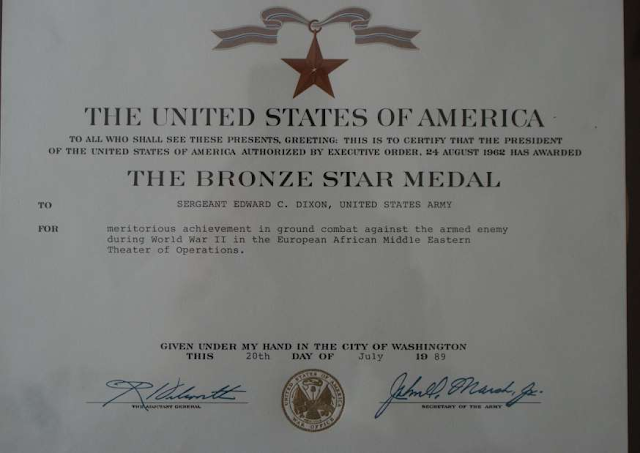
Teddy Dixon eventually received his Bronze Star from the US Government in 1989

“I was one of the first 12 soldiers to enter the gates of Dachau camp on April 29 and can still see the bodies in my mind’s eye,” Teddy recalled in 2009.

“The dead were lying everywhere and the smell was indescribable. We found one man who had been left for dead in a carriage but was still alive and we got him some medical attention. We gave our rations to as many of those who could eat but it was too late for several who died in front of our eyes.

“It was like going into Hell.”

In March this year, members of Teddy’s family travelled thousands of miles to be with him for a busy round of birthday celebrations.

Speaking to the News Letter in 2014, he said the vivid memories would never leave him, but he continued to carry out speaking engagements to raise awareness of the warning from history.

“I still like doing the talks in schools but it can annoy you a bit sometimes when you think about it. Many a time when I wake up I find I’ve been dreaming about the Holocaust,” he added

With Teddy Dixon’s war record reading like the plot of a Hollywood film, it was no surprise that George Clooney brought one of the Belfast man’s adventures to life in a blockbuster movie.

The Monuments Men, released in 2014, was based on the story of the Nazis’ looted art treasures Teddy helped recover from an Austrian salt mine.

Each one of thousands of priceless artworks – including Michelangelo’s ‘Madonna of Bruges’ sculpture and Vermeer’s painting ‘The Astronomer’ – had been packed on to several train carriages and hidden in the mine close to Altaussee.

At the film’s launch, the then 94-year-old Teddy was a Movie House cinema guest for a special screening in Belfast.

He told the News Letter afterwards: “I enjoyed it. It was definitely based on fact and quite well done based on my point of view of having been in the mines. It brought back a lot of memories.”

100th birthday celebrations for Teddy Dixon


How often should we shower, according to science?

The internet (like Siri) has become an oracle to which millions of people turn every day hoping to resolve their countless doubts. Google kn...