 |


 |
| Other circles were made of wood and were used for parties |
It is an enormous feat if we consider the difficulty that could have been almost 3,000 years ago transporting these enormous slabs. They were not moved by magic by Merlin, as legend has it, but they were pushed by men with hardly any tools. In addition, this strange circle is very different from others found near it or discovered in regions as remote as Germany or Portugal.
According to LiveScience, these 'henges' or circles (as British archaeologist Thomas Kendrick named them in 1932) normally surround an interior trench. However, Stonehenge is the other way around: the monument is inside the ditch. And it is not the only difference.

The builders of Stonehenge passed through Spain before reaching the UK
They came from the area of Anatolia, what is now Turkey, and settled in the Iberian peninsula before continuing northward.
Most of these circles were made of wood. Obviously few have survived, but in the 20th century they began to discover their existence thanks to aviation: "After the First World War, when people began to fly over the country, they began to see where these constructions had been because they left traces in the ground with its mounds. People didn't realize it until they had a bird's eye view, "said Rosemary Hill, the historian who wrote the recent study.
At Stonehenge you don't eat
This type of construction was common in England, but has also been found in Ireland, in the region of French Brittany and even near Berlin or in Portugal. It is believed that there could be many more yet undiscovered.
"Stonehenge is a mystery, whether you are a Druid or an anthropologist or a New Age"
There are innumerable theories for these circles and, above all, for Stonehenge: it has been said that they were sacred hunting places, meeting places, astronomical calendars, structures for the amplification of sound, cemeteries, sanatoriums or even places to organize a kind of barbecue of the time. For example, in the Durrington Walls henge, just 2 miles from Stonehenge, remains have been discovered indicating that people flocked there to feast on. However, in the mysterious stone monument it does not appear that it was eaten.
Human remains have been found at Stonehenge, "so it is strong evidence that it was a burial site and is oriented towards the setting sun during the winter solstice," Hill said. "So I think you can say that it has to do with the dead and the solstices. It is not unreasonable to think of it as a ritual site and there is no evidence that people eat or live there."


Sergei Eisenstein premieres in Moscow 'The Battleship Potemkin', the film that narrates the revolutionary uprising of the Russian sailors in 1905, considered one of the best films in the history of cinema.
 |
| Still from 'The Battleship Potemkin' (1925), massacre on the famous Richeliey staircase |
In 1925, on the occasion of the commemoration of the twentieth anniversary of the failed revolutionary coup in 1905, the Soviet government commissioned the young director Sergey M. Eisenstein - who had achieved great success with his first feature film The Strike - to make a film that included those facts.
Eisenstein's initial idea when writing the script was to film the 1905 uprising: on June 27 of that year, the crew of the Potemkin, one of the best battleships in the Russian Black Sea fleet, mutinied because of the harsh conditions of life to which they were subjected. The event became a prelude to the 1917 revolution, setting a precedent in the difficult digestion from the Russo-Japanese War to the uprising against the Tsar.
Filming in Leningrad was interrupted by weather setbacks and the crew moved to the port city of Odessa, where scenes for the film were scheduled to be shot. Once there, Eisenstein changed his mind and decided to focus the script around the mutiny of the battleship Potemkin.
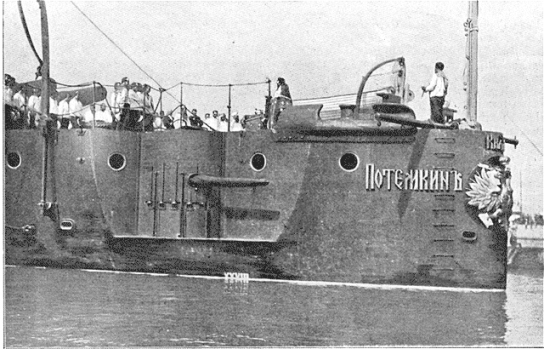 |
| The stern of the battleship in 1905, with its name Potemkin (in Russian, Потёмкин) |
The filming took place in just three months, during which time Eisenstein sought testimonies of the event and rewrote the project in five parts: Men and Worms, Drama in the Bay, The Dead Calls for Justice, The Odessa Ladder and Encounter with the fleet.
Filmed with non-professional actors, Eisenstein manages to highlight the expressiveness of the performers in the close-ups and an aesthetic where the exaltation of the group grows stronger as the film unfolds. Thus the sequence of the massacre on the now famous Richelieu staircase –the baby's stroller sliding down the stairs –has been honored by prominent directors such as Brian De Palma in The Untouchables of Elliot Ness or Woody Allen in Bananas.
 |
| Filmed with non-professional actors, the expressiveness of the close-ups and an aesthetic where the exaltation of the group is gaining strength as the film unfolds stand out. |
Eisenstein made a film that reproduces a triumphant uprising despite the fact that the script does not fit reality: the massacre was a fiction created by himself against the Tsar
The real Potemkin, after escaping among the Russian army fleet, which did not open fire on the battleship, ended up in Constance, Romania, where the crew handed the ship over to the authorities, who returned it to the Russian government.
 |
| Scene from the film in which the crew indignantly observe the rottenness of the meat they eat every day |
According to the testimony of Eisenstein himself, the montage (whose last roll he would splice with his own saliva), was finished moments before the projection of the film
Heavily censored, in Spain it was screened at ‘Studio Cinaes’ at the Lido Cinema on November 7, 1930 and circulated clandestinely until its re-release in Madrid in August 1977 and in September of the same year in Barcelona.
The jury of the International Exhibition of Brussels granted the totality of votes to the film. At the 1st International European Film Festival, a vote of 6,000 filmmakers chose 'The Battleship Potemkin' as the best European film of all time.
 |
| The bombing claimed 270 lives |
The bombing of Pan Am flight 103, travelling from London to New York on December 21 1988, killed 270 people in Britain’s largest terrorist atrocity.
Former Libyan intelligence officer Abdelbaset al-Megrahi, who was found guilty in 2001 of mass murder and jailed for life with a minimum term of 27 years, was the only person convicted of the attack.
US media report that the country’s justice department expects to unseal charges in the coming days with the Wall Street Journal and New York Times naming Abu Agila Mas’ud as the suspect.
 |
| Dr Jim Swire lost his daughter Flora in the atrocity |
Dr Jim Swire, who lost his daughter Flora in the attack, is convinced that the late Megrahi was innocent.
He told BBC Breakfast: “My position has been difficult in that I cannot bring myself to feel that the evidence we’ve heard so far does in fact point us towards the truth of who committed those 270 foul murders back in 1988.”
Asked whether he thinks Mas’ud may be able to offer information, he said: “I cannot see how a connection can be made to the Lockerbie bombing with this guy but it is quite possible that it may be.”
He added: “I do hope that with what’s going on at the moment coming up to the 32nd anniversary of this awful business on Monday that some truth will come out of what’s happening now.”
Megrahi was released from prison in 2009 on compassionate grounds while terminally ill with cancer.
He returned to Libya and died in 2012.
A panel of five appeal judges in Edinburgh is currently deliberating on whether to acquit Megrahi over the Lockerbie bombing after the conclusion of the third appeal against his conviction last month.
The internet (like Siri) has become an oracle to which millions of people turn every day hoping to resolve their countless doubts. Google kn...


