
Flåm Railway, Norway
The rail journey across southern Norway from Bergen to Oslo – northern Europe’s highest mainline railway – is so beautiful that all seven hours of it were broadcast in 2009 on Norwegian television as the first ever Slow TV (Sakte-TV) programme. However, for passengers who alight at remote and tiny Myrdal an even greater pleasure awaits. The branch line from here down to Flåm is one of the world’s steepest railway lines, dropping 867m in just 20km, and was created in 1940 to serve villages along Sognefjord. Along the way, it provides vistas of the fjord, along with mountains, the picturesque Lake Reinungavatnet and myriad waterfalls, including the mighty 93m Kjosfossen.

West Highland Line, Scotland
Although the Cambrian Coast Line in Wales and the Highlands’ Kyle of Lochalsh Line both make compelling claims to be Britain’s most scenic railway, there’s really no competing with the West Highland Line for the variety and splendour of the landscapes it passes through. Running from Glasgow north to Mallaig, with a branch line off to Oban, the line passes hills and mountains before hauling itself up onto Rannoch Moor, a slice of wilderness that brings a sense of awe. The remote station at Corrour – familiar to fans of the Trainspotting films – is the highest in Britain (408m), while beyond lies Glenfinnan Viaduct and the craggy coastline, with its views out to the Small Isles.

Rome to Palermo, Italy
It’s not every rail journey that involves a bonus sea voyage. Board the direct service from Rome to the Sicilian capital, though, and you’ll find your train shunted onto a ferry to be carried across the Strait of Messina. The trip takes a little under 12 hours in total, passing down the Tyrrhenian Sea coastline. Highlights en route include Mount Vesuvius, the Bay of Naples and the countryside of Calabria, Italy’s toe. After a short passage across the waves, the train offers views of the north coast of Sicily as it heads westward to Palermo.

Mariazellerbahn, Austria
Clocking in at an impressive 78km, the Mariazell railway is the longest narrow-gauge line in Austria and has been running since 1907. It starts its journey a little to the west of Vienna, at St Pölten, one of Austria’s oldest cities. After gliding along the scenic Pielach valley the train pushes up into the mountains, heading for the Ötscher-Tormäuer Nature Park and Gemeindealpe Mitterbach ski resort, its passage smoothed by 19 viaducts and 21 tunnels, before arriving at Mariazell, a place of pilgrimage for more than 800 years. A steam locomotive takes over pulling duties on selected dates from May to October, while at the weekends and during Advent, first-class panorama carriages offer an even better view of the scenery.

Stockholm to Narvik, Sweden-Norway
If you want to travel direct from the Swedish capital to Narvik, one of Europe’s most northerly railway stations, your only option is the Norrlandståget sleeper. Happily, this is a route that gives the lie to the notion that beautiful scenery is wasted on sleeper trains. Go in summer when the night barely gets dark and you can watch the hypnotic passing of forests and lakes from the comfort of a snug berth. Travel in winter and you may see the night sky illuminated by the northern lights. The train takes nearly 19 hours to cover the 1,000km journey up eastern Sweden, crossing the Arctic Circle into Lapland, squeezing between mountains and Lake Torneträsk before finally heading into Norway.
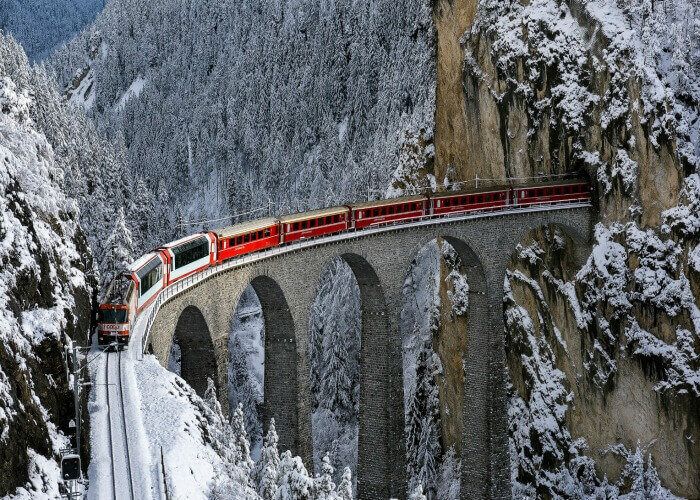
Glacier Express, Switzerland
The Swiss have produced some of the most gloriously picture-perfect railway lines on the planet, their trains gliding along Alpine valleys or climbing doggedly up unfeasibly steep inclines to mountain fastnesses. The Glacier Express between St Moritz and Zermatt is perhaps the cream of the crop, cutting through the Alps on its journey from the Matterhorn to Piz Bernina mountains. An extraordinary feat of engineering that involves 291 bridges and 91 tunnels, the railway is a Unesco world heritage site. It would be a shame to pass through such scenery quickly, so this “express” service takes nearly eight hours to travel less than 300km, allowing passengers plenty of time to gaze out of the panoramic windows at the majestic surroundings.

Mainz to Koblenz, Germany
A must for fans of German wine and fairytale castles. This route along the Rhine cruises past the seemingly limitless vineyards that rise up along the steep banks of the river. Thrusting between mountains, it passes many of the flamboyant castles that inspired Disney and takes in the famous cliff at St Goarshausen, where Loreley’s siren song once brought sailors to grief. Although the fastest express trains complete the journey in 50 minutes, the more relaxing Mittelrheinbahn RB26 stopper services between Mainz and Cologne take nearly an hour and a half to chug along the Rhine’s left bank – time enough to admire the fetching old-world towns and villages as you sip a glass of riesling, or a floral Gewürztraminer.

Nice to Digne-les-Bains, France
A hundred years ago there were four metre-gauge railway lines that made up the Train des Pignes (Pine Cones Train) in southern France. Now the only survivor is this 150km route from Nice, on the Mediterranean coast, up to the spa town of Digne-les-Bains, the capital of the Alpes-de-Haute-Provence department. This is not a train in a hurry. Aside from the regular stations en route, there are dozens of tiny “halts” at which passengers may alight or board. Wending its way slowly upwards beside the River Var, the train visits medieval towns and compact villages before its arrival, over three hours later, in Digne on the edge of the Alpine foothills.

Levanto to La Spezia, Italy
The journey along the Italian riviera from Levanto to La Spezia may only take 35 minutes, but it includes the most sublime stretch of the Ligurian coast – the popular Cinque Terre (Five Lands). The pastel-coloured villages have been nestled in the cliffs for a thousand years or so, and along with their olive groves and vineyards make up an exquisite scene. For the full experience, take the regional train rather than the express: this stops at all five Cinque Terre villages – Monterosso, Vernazza, Corniglia, Manarola and Riomaggiore – allowing passengers to hop off, hike between villages, and hop back on a train again.

Bar to Belgrade, Montenegro-Serbia
The fact that the Montenegro Express has to travel through 254 tunnels and over 435 bridges to climb from the seaport of Bar to the Serbian capital gives an indication of the spectacular scenery through which it passes. A relatively modern line – it opened in 1976 – it pulls away from the Adriatic, runs by Lake Skadar, southern Europe’s largest lake, and into the mountainous Biogradska Gora national park. Clipping a corner of Bosnia and Herzegovina, the train negotiates its way through Serbian hills before finally arriving at Belgrade’s Topčider station, 12 hours and 475km later. Look left just beforehand and you’ll get a glimpse of Marshal Tito’s deluxe private train.


