Es mostren els missatges amb l'etiqueta de comentaris primera guerra mundial. Mostrar tots els missatges

dimecres, 10 de febrer del 2021

Tyne Cot eng

 https://youtu.be/aSEr4LQQ2ys


Tyne Cot Commonwealth War Graves Cemetery and Memorial to the Missing is a Commonwealth War Graves Commission Cemetery (CWGC) for the dead of World War I on the way out of Ypres on the Western Front. It is the largest Commonwealthforces cemetery in the world, for any war. The cemetery and its surrounding memorial are located outside Passchendale, near Zonnebeke in Belgium.

The name "Tyne Cot" is said to come from the Northumberland Riflemen, seeing a resemblance between the German forts at this site and typical Tyneside workers' houses (Tyne cradles). Tyne Cot CWGC Cemetery is located in a vast expanse in the landscape overlooking the surrounding countryside. As such, location was strategically important for both parties fighting in the area. The concrete shelters still standing in various parts of the cemetery were part of a fortified position of the German Flandern I Stellung, which played an important role in the area during the Battle of Passchendaele in 1917.

Tyne Cot Commonwealth War Graves cemeteries

On 4 October 1917, the area where Tyne Cot CWGC Cemetery now stands was captured by the 3rd Division of Australia and the New Zealand Division and two days later in a British War Cemetery. and Canadian started. The cemetery was captured by German forces on 13 April 1918 and finally liberated by Belgian forces on 28 September.

After the armistice in November 1918, the cemetery was largely expanded from its original 343 graves by the concentration of battlefield graves, smaller nearby cemeteries and from Langemark.

The cemetery grounds were allocated to the United Kingdom in perpetuity by King Albert I of Belgium, in recognition of the sacrifices made by the British Empire in defending and liberating Belgium during the war.

The sacrificial cross that marks many CWGC cemeteries was built on top of a German fort in the center of the cemetery, allegedly at the suggestion of King George V, who visited the cemetery in 1922 as the conclusion was approaching. The visit of the King, who is described in the poem of the king Pilgrimage, including a speech in which he said:

We can truly say that the entire circuit of the Earth is girded with the graves of our dead. In the course of my pilgrimage, I have often wondered if there may be more powerful defenders of peace on Earth through the years to come, than this massive crowd of silent witnesses to the desolation of war.

- King George V, May 11, 1922

The cemetery was designed by Sir Herbert Baker. The land on which the cemetery stands is the free gift in perpetuity of the Belgian people to those who are honored here.


Angel Falques in Passchendaele


Notable tombs

The cemetery has several notable tombs and monuments, including the tomb of Private James Peter Robertson (1883-1917), a Canadian awarded the Victory Cross for his courage in undertaking a machine gun location and rescuing two men under fire heavy. He was killed by rescuing the second of these men on November 6, 1917.


Two Australian Victory Cross recipients buried in the cemetery are Captain Clarence Smith Jeffries (1894-1917), and Sergeant Lewis McGee (1888-1917). Jeffries led an assault group and rushed one of the strong points into the First Battle of Passchendaele on October 12, 1917, capturing four machine guns and thirty-five prisoners, before executing his company again. forward. He was planning another attack when he was killed by an enemy gunner. On the same day, McGee, who had won his decoration eight days earlier at Broodseinde, died collecting an enemy box of pills in the same battle.


Also in Tyne Cot, behind the sacrificial cross that was built on top of an old German fort in the center of the cemetery, are 4 German tombs, buried next to the Commonwealth tombs. These tombs are of the men who were treated here after the battle, when the fort under the main cross was used as a place of relief for the wounded.


.


Tyne Cot Memorial to the Missing

The stone wall surrounding the fa-el-Tyne Cot Memorial Cemetery to which it was lost, from several war tombs State Monument Commission along the Missing Western Front. The missing UK loses on the way out of Ypres are commemorated at the Menin Gate and the Tyne Cot Memorial. At the end of the Menin Gate in memory of the missing in Ypres, the builders discovered that it was not large enough to contain all the names as originally intended. An arbitrary cut-off date of 15 August 1917 is selected and the names of those who disappeared in the UK after that date were inscribed on the Tyne Cot memorial in its place. In addition, the New Zealand contingent of the Commonwealth War Graves Commission declined to have their names missing soldiers appearing on major monuments, choosing instead to have names listed near the appropriate battles. Tyne Cot was chosen as one of these places. Unlike other New Zealand monuments in its absence, the Tyne Cot New Zealand Memorial to the Missing is integrated into the largest Tyne Cot monument, forming a central apse on the main monument wall. The inscription reads: "Here are recorded the names of the officers and soldiers of New Zealand who fell in the Battle of Broodseinde and the First Battle of Passchendaele in October 1917, and the tombs are known only to God."


The monument contains the names of 33,783 soldiers from UK forces, plus another 1,176 New Zealanders. Three British Army Victoria Cross receivers are commemorated here:

· Lieutenant Colonel Philip de Bent (1891-1917)

· Corporal William Clamp (1891-1917)

· Private Ernest Seaman (1893-1918)

Other notable commemorations include:

· Lieutenant Allan Ivo Acer, first class English cricketer.

· Lieutenant David (Dai) Westacott, Welsh rugby international

· It was designed by Sir Herbert Baker, with sculptures by Josep Armitage and winner Ferran Blundstone, which is also a part of the Newfoundland National War Memorial


The memorial was presented on June 20, 1927 by Sir Gilbert Dyett.

divendres, 18 de setembre del 2020

The Battle of Passchendaele


The official name of the battle is the 3rd Battle of Ypres, but it is universally known as the Battle of Passchendaele because the capture of Passchendaele town and its ridge (Passchendaele ridge) eventually became the primary objectives of the operation. The battle began on July 31, 1917 with an attack northeast on Pilckem and right on Gheluvelt ridge. The attacking troops in the Pilckem sector were supported by massive tanks. Initially the advance was successful, but unfortunately the right flank failed in its attempt to take Gheluvelt ridge.

Later, at four in the afternoon it started to rain. The rain lasted for several days and of course the land was flooded and made the advance of the tanks impossible.

Although Haig had the original purpose of a brief battle to break through the German lines it was revealed that it was impossible. Despite this, Haig insisted on continuing operations further north in the Langemarck area. General Gough, selected for his aggressiveness to carry out the main attack, warned Haig about the impossibility of continuing and urged him to call off the attack. But Haig inflexible as always ordered to continue the attack, despite the terrible losses. The totally sterile attack lasted three more weeks until he decided to suspend it. Then he decided to change the axis of the attack, from north to east, and by the time the weather cleared he ordered the ridge to attack again. Haig also decided to replace Gough with General Plumer who would be in charge of the next attack. Plumer, one of the most cunning and intelligent generals in the British General Staff, was in favor of carrying out small-scale attacks under the cover of an intense barrier of fire that would also discourage German counterattacks. This strategy led to the accumulation of large numbers of troops in a very narrow front, which facilitated the relief of exhausted troops and the provision of food and ammunition. The troops would advance behind a screen of fire and would be hidden and camouflaged under the smoke and dust of the explosions. However, these forecasts would be nothing if the rain made an appearance and the terrain became a viscous and impractical element.

The Battle of Menin Road on September 20 was the first of three famous victories that were achieved through the use of Plumer's new programmed tactics. At dawn on the fifth day, after five days of uninterrupted bombardment, the ANZACS launched a victorious attack with two Australian divisions on both flanks and a Scottish division to the left to reinforce the flank. One of the most notorious episodes of this attack was that of Australian 2nd Lieutenant Fred Birks. Birks led the heroic takeover of a machine gun company located in one of the German fortifications, eliminating the enemy and capturing the weapons. After this action he organized a party to take another of the fortifications that ended up taking 16 enemy soldiers, one of them the commanding officer. Birks died shortly after a shell blast while digging trenches for the shelter of his platoon. He was posthumously awarded the Victoria Cross. His body lies in the Perth Cemetery in Zillebeke (Grave I.G. 45).

Tyne Cot Cemetery

The Australians reached the bottom of Polygon Wood and Black Watch Corner at a cost of 5,000 casualties. They were relieved, and the captured sector consolidated by installing a small railway line to ensure the delivery of supplies to the new front line. On September 26 the good weather continued and the ground conditions were still optimal for Plumer's curtain of fire to continue and the Anzacs to continue. The Australian 4th Division captured the remainder of the Polygon and Butte position. They had managed to reach a position from which it was possible to attack the bulk of the Broodseinde ridge (Broodseinde ridge). The Battle of Broodseinde took place at dawn on October 3. The Australian troops waiting to attack were bombarded in their own trenches by enemy mortar fire, and when they jumped out of the trenches to attack they were surprised to see how the German troops used their own fire barrier to advance towards the Australian positions, curiously, found themselves face to face in the middle of No Man's Land. However, the Germans were eventually driven back by an Australian bayonet charge. At this point, a German machine gun began to sweep through the front Australian ranks, slowing down part of the attack. Then Sergeant Lewis McGee, armed only with a revolver, traveled about eighty meters under the bullets, finally taking the machine gun and reorganizing the attack again. McGee was awarded the Victoria Cross for outstanding leadership. Unfortunately he died on October 12 without knowing his mention. His body lies in Tyne Cot Cemetery Grave No. XX.D.1.

After the Australian bayonet charge, the German troops withdrew to their trenches. There, together with other reserve troops, they were crushed by British artillery. The Australians continued the advance under the barrier of fire and finally managed to take the Broodseinde ridge on 4 October. When the Australian troops reached the ridge, they saw the drawing of the German lines crystal clear. The only obstacle to victory was the town of Passchendaele located to the north and which was heavily occupied by the Germans. These three fantastic victories vindicated Plumer's strategy of going step by step, although they were possible because time gave them a truce and the ground was dry enough to allow a breakthrough. The next day, October 5, it started to rain. It was not torrential rain, but a constant rain that ended up soaking to the bone. Haig, encouraged by the three successes, ignored the rain and decided to launch another attack on the Germans on the Passchendaele ridge. He even warned the cavalry to be ready for the attack. He ordered the Anzacs to take Passchendaele on October 9 even when the wind and rain had raised a terrible storm. Haig's decision was reckless as conditions were utterly adverse: the belts of barbed wire had not been cut and the Germans had replaced their exhausted troops with fresh reinforcement units sheltered from the elements in their concrete fortifications. The main reason for Haig's insistence on continuing the attack was to prevent his troops from having to remain all winter in a Dantean scenario, with extreme weather conditions, and above all with the constant threat of being within range of the German positions without coverage.

Tyne Cot Cemetery

The Australians attacked and in Augustus Wood, near Tyne Cot, Captain Clarence Jeffries, with an assault platoon, in the attack on a German fortification, captured four machine guns and took 35 prisoners. Position secured Jeffries led the attack to the next German position but fell under the bullets of a German machine gun. He was posthumously awarded the VC and his grave is in Tyne Cot Cemetery, not far from that of Sergeant McGee. According to John Laffin, all the officers in the battalion were killed or wounded that day.

Incredibly, and largely because of the courage of Captain Jeffries, twenty Australian soldiers reached the ruins of what was once the church of Passchendaele. Unfortunately, the British troops, from the right flank, were unable to hold and support the Australians, who were forced to retreat into the craters flooded with water and mud that the howitzers and torrential rains created and that was their front line. original. The British artillery had no reserves of ammunition, and the few shells that fell did so by sinking into the slimy mud, turning into harmless columns of mud and water. Despite all this, Haig decided to continue the attack, even as rain and freezing cold made their appearance on October 12. The attack was hopelessly doomed to failure. The slimy sea of ​​mud invaded everything and made the sacrifice of the troops as absurd as it was inhuman.

It was in this attack that Sergeant McGee was killed. The only solid objects in the middle of this sea of ​​crater-spattered mud were the German concrete fortifications, which with their machine guns under the camouflaged protection of the mud caused many casualties. The attack cost 7,000 casualties. 3,200 soldiers from the Australian 3rd Division died in just 24 hours. In the end, the exhausted Australian troops were withdrawn, but Haig, pathologically obsessed with taking Passchendaele, ordered the Canadians to end the battle. However, Canadian General Arthur Currie, one of Haig's few generals with common sense, adamantly refused to advance until weather conditions improved and troop supplies were adequate.

Finally, on November 12, the Canadians took Passchendaele, or what was left of it.

The battle was over, and aerial photographs were taken after it. It is estimated that there were more than half a million craters in the area where the town of Passchendaele had once stood. This was what Haig hoped, for his troops to spend the winter there. The results of the offensive were Pyrrhic: the predictions of breaking the enemy lines were not fulfilled, and the few gains were at a very high price in human losses. The British had achieved their objective, although it was totally useless in terms of strategic planning as the amphibious attack on Nieuport had been abandoned and there was no longer any hope of capturing the German ports, which were finally blocked with the sinking of old ships. in Zeebrugge.

Tyne Cot Cemetery

The Battle of Passchendaele claimed more than half a million dead in three months. The Germans lost about 250,000 men and the British about 300,000, of whom more than 36,000 were Australians. More than 90,000 bodies of Australian or British soldiers could not be identified, and around 40,000 were never recovered, dwelling forever in the hideous quagmire. Many of those who drowned were wounded or exhausted soldiers who had slipped or fallen from the wooden walkways that crossed the huge craters or puddles created by the howitzers and who were unable to escape the disgusting and nauseating slimy sludge that had become. battlefield.

Passchendaele was the last war of attrition of the Great War, and it still remains in memory as a futile battle, just like that of the Somme a year earlier. The criticisms lie, above all, in the fact that a year after the battle of the Somme, Passchendaele was a carbon copy in terms of strategy and tactics, not so much in weapons.


diumenge, 21 de juny del 2020

The Australian book you've finally got time for: The Middle Parts of Fortune by Frederic Manning

Soldiers climbing over their trench on the first day of the Battle of the Somme, 1 July, 1916.
Why hasn’t Anzackery’s ever-rising tide washed Frederic Manning and The Middle Parts of Fortune further up the Australian literary shore?

Every Father’s Day and every Christmas publishers search, with increasing desperation, for fresh presentations of the Australian Great War experience. On that basis, one might have expected a combat novel lauded by Ernest Hemingway, TS Eliot, Ezra Pound, TE Lawrence and other immortals to exert more of a cultural presence.

But while Frederic Manning “revivals” have been announced ever since the 1960s, the canon invoked during Anzac season still somehow begins and ends with Wilfred Owen, Siegfried Sassoon, Robert Graves and, perhaps, Charles Bean.

The problem might be traced to Manning’s marked divergence from the rugged Digger archetype celebrated by Bean and his acolytes.

The son of a wealthy Sydney financier, Frederic was always delicate and bookish. At the age of just 15, his parents allowed him to depart for England with his much-older tutor, the Reverend Arthur Galton – a man who’d once moved in the same Oxford circles as Oscar Wilde and Lord Alfred Douglas. Together, they moved into the tiny village of Lincolnshire, where they maintained an intense (but perhaps non-sexual) relationship that shaped the boy into a scholar-aesthete like his mentor.
Biographer Verna Coleman describes Manning as “the Last Exquisite”, both because of the delicacy of his prose and because of a brittleness that prevented him from capitalising on his early literary success. By 1928, his peers regarded Manning as talented but strangely old-fashioned: a chain-smoking, semi-alcoholic asthmatic with a bad back and poor digestion, more attuned to the aestheticism of the 1890s than contemporary modernism, and congenitally incapable of completing a major work.
But that year the publisher (and fellow veteran) Peter Davies urged Manning to write about his experiences on the Somme – and locked him in his apartment until he did so. Supposedly, Manning wrote his loosely-fictionalised account entirely without revision, with Davies forestalling procrastination by rushing each chapter from the typewriter straight to print.
The Middle Parts of Fortune appeared anonymously in a volume only available to subscribers, with a bowdlerised edition subsequently released to the public under the title Her Privates We (another reference to the bawdy passage in which Hamlet declares fortune “a strumpet”).
The problem was language: rather unexpectedly Manning, the fastidious aesthete, had reproduced the genuine wartime vocabulary instead of the euphemisms to which other (more obviously transgressive) novelists resorted.
Yet in other ways The Middle Parts of Fortune also conveys the deep gulf between now and then.
It follows the experiences of a private called Bourne – an obvious surrogate for Manning – for a few months on the Somme and Ancre fronts.
Critics have praised the book for celebrating the ordinary soldier, largely because its protagonist stays in the ranks rather than accepting the commission to which his education suits him. Yet Manning portrays Bourne as more misfit than egalitarian, alienated from the English officers as an Australian who didn’t attend a public school, and separated from the other men by his erudition.
Indeed, isolation defines the war, an experience that, despite moments of camaraderie, every man endures in solitude.
“One by one,” Manning writes, “they realised that each must go alone, and that each of them already was alone with himself, helping the others perhaps, but looking at them with strange eyes, while the world became unreal and empty, and they moved in a mystery, where no help was.”
The highly strung, deeply repressed man [was] always slightly out of kilter with his era
It’s that profound atomisation, conveyed in Manning’s finely wrought prose, that makes the book’s brief and hallucinatory battle scenes so terrifying, with modern combat a sensory overload inflicted on the individual psyche.
Famously, Wilfred Owen describes his subject as “the pity of war”. Manning takes a very different approach.
“To call [war] a crime against mankind,” he says in his introduction, “is to miss at least half its significance; it is also the punishment of a crime.”
Where militarists like Ernst Jünger show the conflict redeeming men through violence, Manning sees wartime suffering as facilitating a peculiar authenticity, as his characters “turn […] from the wreckage and misery of life to an empty heaven and from an empty heaven to the silence of their own hearts”.
We might go so far as to say that Manning’s war reflected Manning’s peace. The highly strung, deeply repressed man always slightly out of kilter with his era seems to have experienced the Battle of the Somme as an intensification, almost to the point of liberation, of the isolation he already felt.
The final words of The Middle Parts of Fortune encapsulate the theme of one of the strangest, most compelling books from the Great War.
“They sat there silently,” the novel ends, “each man keeping his own secret.”

dissabte, 30 de maig del 2020

Battle of Jutland warship’s four years since restoration marked in lockdown

HMS Caroline in Belfast will mark the fourth anniversary of its refurb in lockdown after having to close in March due to the coronavirus pandemic.

A Battle of Jutland warship is set to mark fourth anniversary of its refurbishment in lockdown.
HMS Caroline reopened as a museum on June 1 2016 following a £15 million refurbishment in Belfast.
However it has been closed since March due to the coronavirus pandemic and has had to furlough 91% of staff due to loss of visitor income.
Before and after images following the refurbishment of HMS Caroline into a museum.

The National Museum of the Royal Navy (NMRN) said the closure of its Belfast-based attraction has had a “devastating impact on its finances”.
Its sites in Portsmouth, Gosport, Hartlepool and Yeovilton have also been closed.
The NMRN receives just 19% of its funding from the UK Government with the remaining 81% having to be self-generated.
NMRN director general Dominic Tweddle said they have been plunged into a “precarious situation”.
“Many will have seen in the media the dire situation facing museums up and down the country but perhaps don’t realise that a National Museum such as ours, faces those same challenges,” he said.
“We have reached out to departments across the Navy, Ministry of Defence (MOD) and Department of Culture, Media and Sport (DCMS) and have had great messages of support; but nevertheless the situation still remains precarious.”
HMS Caroline’s ward room before and after recent renovation
HMS Caroline, the last survivor of the 1916 Battle of Jutland, was last year short listed in the 2019 Art Fund Museum of the Year.
Mr Tweddle described stepping on board as “embarking on a journey across one hundred years of naval history”.
“We know that the relationship between HMS Caroline, Belfast and its people is special and that our work is integral in supporting the local economy,” he said.
“Currently 91% of the staff at HMS Caroline have been asked to take furlough leave, something that has been critical in helping us manage our financial position.
“I can only thank them for their support in doing this.
“However, we do still have a team of essential workers on site and it is fantastic that we can bring details of the work that they are doing to audiences online you can follow the NMRN on @natmuseumrn or facebook.com/NatMuseumRN/”
Whilst HMS Caroline is currently closed to the public for anyone wishing to support the National Museum, donations can be made via nmrn.org.uk/donate.

dimarts, 7 de gener del 2020

1917: five stars for "dazzling and profoundly moving" film

The epic 1917 follows two soldiers on a mission to save 1,600; with “astonishing” cinematography and direction, Caryn James writes “it’s one of the most stirring films of the year”. 


The baby-faced soldier running toward the camera in 1917 perfectly captures what was so heart-breaking and haunting about World War One – all that innocence sent into battle, all those futures destroyed. Perhaps no film can capture the enormity of that war, which left around 17 million dead, and generations to grieve. Director Sam Mendes wisely takes the opposite approach, personalising the experience through two young British soldiers sent on a harrowing, high-stakes, night-long mission, he creates a film that is tense, exhilarating and profoundly moving.

Blake (Dean-Charles Chapman) is that baby-faced soldier. Schofield (George MacKay) is not much older but seems world-weary, having already been in combat. Mendes immerses viewers in the young soldiers’ experience when they are sent on foot across no-man’s land with a message that could prevent a slaughter. They must reach British forces at the front line before dawn with orders to call off a planned attack on the Germans, who have staged an ambush. With phone lines down, the fate of 1,600 men rests with these two messengers.
Mendes’ audacious strategy behind the camera has already received a great deal of attention. Filming in extremely long takes and making as few editing cuts as possible, he creates the illusion of one continuous movement as the soldiers run through trenches and across muddy fields. The technique is dazzling, but it is more than a stunt. It enhances tension and immediacy, allowing us to feel connected to the two heroes. 
That connection is primarily thanks to the actors, though. Chapman (Game of Thrones) and MacKay (Captain Fantastic) are marvels of naturalness on screen. For Blake, the mission is personal because his brother is among the likely casualties if the attack goes forward. It’s a connection that the general who chose him for the mission (Colin Firth) ruthlessly exploited. In the early stretches of the journey, before the action and danger intensifies, Blake talks about home. Chapman’s rosy cheeks might have been enough to signal innocence, but the performance captures the unquestioning goodness of the character, too young to be in such danger, determined to save his older brother.

Schofield is quieter and has to be drawn out, reluctantly admitting that he won a medal for fighting at the Somme, a medal he doesn’t prize and no longer owns. Despite his disillusionment, he is just as committed to their mission and protective of Blake. His character has the greater trajectory in the film, and MacKay comes through with a quietly astonishing performance. When he grapples with a difficult question Blake poses, you can see his thoughts churning as he hesitates before answering. His face looks increasingly haunted with grief.

In addition to Firth, Andrew Scott and Benedict Cumberbatch make brief appearances as British officers. But the film rightly belongs to Chapman and MacKay, whose lesser-known status helps us believe in their authenticity.


If much of the advance publicity about 1917 has been about its technique, one reason may be that the most suspenseful and most wrenching episodes come as shocks. To be more detailed about why the film is so moving would be to give away too much. Another reason is that Mendes’ direction and Roger Deakins’ cinematography are truly astonishing. As Blake and Schofield set out through the trenches, the camera moves swiftly backwards with them as they race toward us. We feel their frantic pace as well as the claustrophobia of being on that narrow path with walls made of mud. When they emerge in no-man’s land, we are with them as they cross a vast landscape strewn with human corpses and dead horses.
The light is a drama in itself, enhancing the feel of every scene, changing from the deep shadows in the room where Blake and Schofield get their orders, to deceptively bright skies, and eventually a huge plume of fire glowing orange against a pitch-black night sky. In addition to American Beauty and the underrated Jarhead, set during the Gulf War, Mendes has directed the last two James Bond films, Skyfall and Spectre. His experience with all that Bond action is put to good use in 1917, which for all its intimacy is laced with spectacular set pieces, with plane crashes and escapes while under enemy fire.

1917 is a tribute to sacrifice and heroism, but it is not naive about the brutal motives that are sometimes behind combat. Mark Strong, a captain along the heroes’ route to the front, advises that if the message is actually delivered, “Make sure there are witnesses,” so the order to stand down can't be ignored. “Some men just want the fight,” he says. More often, Mendes resists philosophising and lets the action – explosively around the heroes and subtly on their faces – express the fraught, complicated, terrifying condition of war.
Like so many families, Mendes’ was touched by World War One. He dedicates the film to his grandfather, who told him stories about his own wartime experience. He has turned those passed-down memories into one of the most stirring films of the year.

dimarts, 10 de desembre del 2019

Famous World War I Battleship Discovered at the Bottom of the Atlantic

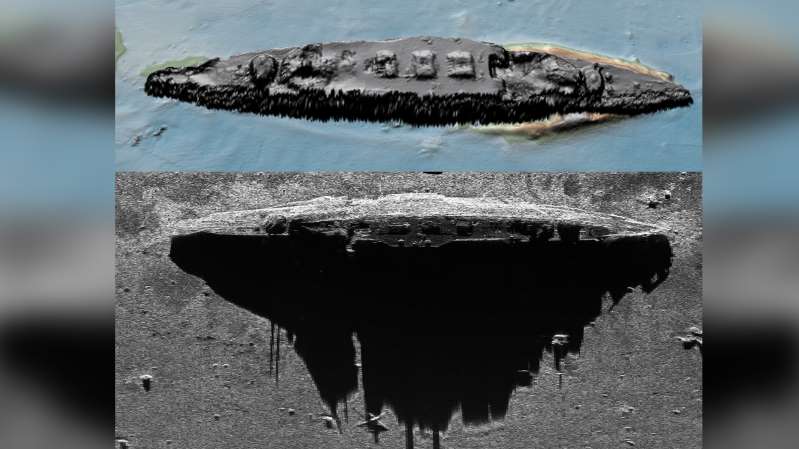
Researchers used two kinds of sonar to detect the wreck of the World War I German battlecruiser Scharnhorst.

The wreck of one of the most famous German warships of World War I has been located on the seafloor near the Falkland Islands, where it sank in a battle with British warships more than 100 years ago.
The battlecruiser Scharnhorst sank on Dec. 8, 1914, with more than 800 crewmembers on board, including German Adm. Maximilian Graf von Spee.
The Scharnhorst had tried to lead a naval attack on the Falklands, but the German squadron was surprised by a larger force of British warships. During the resulting Battle of the Falkland Islands, the British sank the Scharnhorst along with eight other German warships. 
Using an autonomous underwater vehicle (AUV) operated from the survey ship Seabed Constructor, researchers discovered the wreck yesterday (Dec. 4) about a mile (1.6 kilometers) beneath the surface of the Atlantic Ocean.
After it was revealed by the AUV’s sonar, the researchers sent down a remotely-operated vehicle (ROV) to take video of the wreck.
"The moment of discovery was extraordinary," marine archaeologist Mensun Bound, the expedition leader, said in a statement. "We are often chasing shadows on the seabed, but when the Scharnhorst first appeared in the data flow, there was no doubt that this was one of the German fleet."
"We sent down an ROV  to explore, and almost straight away, we were into a debris field that said 'battle,'" he said. "Suddenly, she just came out of the gloom with great guns poking in every direction." 
The wreck of the World War I German battlecruiser Scharnhorst was found beneath more than 5,000 feet of seawater near the Falkland Islands in the South Atlantic.

Searchers started looking for the wreck of the Scharnhorst and other warships from the German squadron in the centenary of the Battle of the Falkland Islands in December 2014, but they were unsuccessful.
The search resumed last month, using four state-of-the-art Ocean Infinity AUVs equipped with sonar instruments to search a 1,730-square-mile (4,500 square kilometers) area of the seafloor near the Falklands.
The wreck was found unexpectedly, when the AUV left its search path to turn around and scan another line of the seafloor — passing over the Scharnhorst during the turn, Bound said. The scientists realized they'd "found" the wreck only several hours later, when the AUV returned to the surface and the data from the search was downloaded and converted into a legible format, Bound said. 
The wreck — which lies on the seafloor about 100 nautical miles southeast of Port Stanley, the capital of the Falkland Islands — has not been touched or disturbed in any way, and the site will now be legally protected, said Donald Lamont, chairman of the Falklands Maritime Heritage Trust. 

Naval battle

The defeat of the Scharnhorst and its warship squadron was a decisive naval battle in the early stages of World War I, according to the Falklands Maritime Heritage Trust.
The Battle of the Falkland Islands came just a few weeks after the Battle of Coronel, off the coast of Chile, when Graf von Spee's East Asia Squadron sank two Royal Navy armored cruisers. More than 1,600 British servicemen were killed in the battle, but only three Germans were wounded.
In response, Britain sent a squadron led by two advanced battlecruisers, HMS Invincible and HMS Inflexible, to the South Atlantic to hunt for Spee and his warships. A month after their defeat at Coronel, the British warships engaged the largest German warships — the Scharnhorst, Gneisenau, Nürnberg and Leipzig. 
The Scharnhorst was the first to sink, after suffering heavy damage from the guns of the Invincible and the Inflexible.
More than 2,200 German sailors died during the battle, including Graf von Spee and his two sons — Heinrich aboard the Gneisenau and Otto aboard the Nürnberg.
The defeat of the East Asia Squadron spelled the end of Germany's hopes to dominate the sea during World War I, and the Imperial German High Seas Fleet was effectively bottled up in the North Sea by the Royal Navy for the rest of the war, according to the British Library
Bound was born in the Falklands, so the discovery of the Scharnhorst has a special meaning. "As a Falkland Islander and a marine archaeologist, a discovery of this significance is an unforgettable, poignant moment in my life," he said.
The search team will now look for the rest of the German fleet sunk in 1914, to better.
understand the events of the battle and to ensure the site's protection, Bound said.


How often should we shower, according to science?

The internet (like Siri) has become an oracle to which millions of people turn every day hoping to resolve their countless doubts. Google kn...